
The Bottom Line First
A chair-supported side step gives you a simple way to practice moving sideways, a direction many everyday tasks require. Research on broader stepping and balance programs in older adults has found benefits for balance and lower fall rates in study settings, but it has not shown that this one exercise prevents falls or builds leg strength. Start with support and keep the steps small.
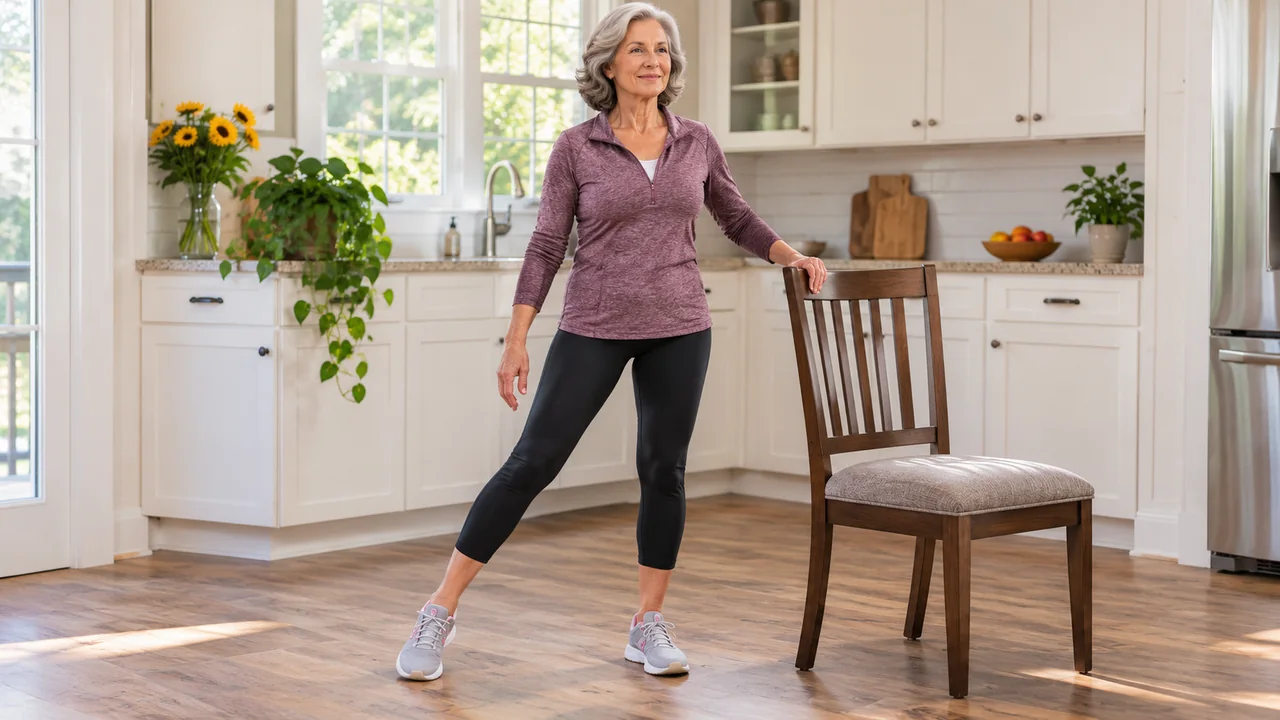
If you saw our social post featuring this move, you may have seen the simple version: hold a sturdy chair, step sideways, bring your feet together, then step back the other way.
It looks simple because it is. But it practices a direction we often overlook. We walk forward, step backward, and climb stairs. We also sidestep around a kitchen counter, move through a tight hallway, or shift sideways while getting out of a car.
The goal isn’t to make a basic movement complicated. It’s to practice it with enough support that you feel steady throughout.
Why Practice Moving Sideways?
Forward walking is useful, but it does not cover every kind of balance challenge. Sideways stepping asks you to shift your weight and place your foot in a different direction. Practicing that pattern can help you get more familiar with the movement.
Research on stepping interventions offers some encouragement, with an important distinction: the studies looked at stepping programs—not this exact chair-supported exercise.
A 2017 systematic review by Okubo, Schoene, and Lord analyzed seven randomized trials involving 660 adults, with study participants aged 60 or older. The stepping programs were associated with roughly half the fall rate among participants compared with control groups. Reaction time and measures of balance improved, but strength measures did not. In other words, the findings support stepping as a way to practice balance and recovery skills; they don’t show that side steps build leg strength or that this particular move prevents falls. Read the Okubo review.
A small 2008 study by Hilliard and colleagues followed 51 screened, independent, community-living older adults for a year. Participants who needed multiple steps to recover balance in every lab trial were more likely to fall during follow-up. Hip-abduction strength added information to the study’s predictions. The researchers’ findings are interesting, but this small study is not a way to assess your own fall risk. Read the Hilliard study.
A broader 2017 review by Sherrington and colleagues included 88 trials and 19,478 community-dwelling older adults. Exercise programs overall reduced fall rates in those trials. Programs that challenged balance and involved more than three hours of exercise per week were associated with a larger reduction. That finding describes a pattern across exercise programs; it is not a recommendation to do three hours of side steps. Read the Sherrington review.
How to Do a Chair-Supported Side Step
Set up in a clear area with:
- A sturdy chair that won’t slide
- A non-slip floor
- Supportive shoes
- Enough space to step in both directions
Stand behind the chair and hold the back lightly, or use both hands if that feels steadier. Step sideways with one foot, bring the other foot in without crossing, then repeat in the same direction. Return by stepping the opposite way.
Keep your torso tall and your steps small enough that you feel in control. For the practice routine shown in our social post, try 2–3 sets of 6–8 small steps each way if that feels steady. Complete six to eight steps in one direction, then return the same number of steps. You can do fewer if that is a better starting point. Smooth, steady steps are the aim—not speed.
Make It Easier or Harder
If the movement feels uncertain, use both hands on the chair, shorten each step, and do fewer repetitions. You can also practice just one or two steps in each direction before returning to your starting point.
Only add a challenge if you have felt steady doing the supported version for two weeks. You might try a lighter touch on the chair. If you progress to hovering your hands briefly above it, do so in a clear space with the sturdy support within reach. Don’t practice unsupported beside hard furniture or while you feel unsteady.
Fit It Into the Week
Try a short practice three times a week, perhaps while the coffee brews. Consistency matters more than turning this into a long routine.
For the strength part of your plan, pair the side step with sit-to-stands. The stepping review did not find strength gains; it found changes in stepping and balance measures. Sit-to-stands offer a separate way to practice rising from a chair and working the legs. See The 5-Minute Strength Routine for Adults Over 50 for another short, practical option.
Common Snags and Simple Adjustments
Your feet cross: Slow down and use shorter steps. Bring your feet close together before moving again.
You grip the chair tightly: That’s fine when you’re learning. Keep the support. Over time, you may find a lighter hold feels comfortable.
Your knee feels uncomfortable: Make the steps smaller and stay within a comfortable range. Stop if you feel sharp pain.
You want more balance ideas: Try our 10-second one-leg balance test article and walking-speed guide. These are information and practice resources, not diagnoses or personal risk assessments.
When to Check With a Professional First
Talk with your clinician or physical therapist before adding balance exercises if you have a history of falls, a balance disorder, dizziness, or a joint replacement. They can help you choose the right level of support and adjust the movement to your needs.
Use a chair that stays firmly in place, keep the floor clear, and stop if you feel pain, dizziness, or new instability.
Coach Bob’s Takeaway
The chair-supported side step is a small practice, not a cure or a guarantee. It gives you a way to rehearse a sideways movement that everyday life sometimes asks for. For practical movement discussions and encouragement, join the Over 50 Fit Life Facebook group.
Want help choosing a steady starting point? Book a free 20-minute strategy session to talk through your goals and exercise options.
This article is general fitness education, not medical advice or a fall-risk assessment. Follow guidance from your own clinician or physical therapist.
Sources
- Okubo Y, Schoene D, Lord SR. “Step training improves reaction time, gait and balance and reduces falls in older people: a systematic review and meta-analysis.” British Journal of Sports Medicine, 2017. PubMed
- Hilliard MJ, et al. “Lateral balance factors predict future falls in community-living older adults.” Archives of Physical Medicine and Rehabilitation, 2008. PubMed
- Sherrington C, et al. “Exercise to prevent falls in older adults: an updated systematic review and meta-analysis.” British Journal of Sports Medicine, 2017. PubMed