
The Bottom Line First
Your usual walking speed can provide a useful snapshot of how well several systems work together: leg strength, balance, coordination, joints, vision, confidence, and heart and lung capacity. That is why researchers often treat gait speed as a practical marker of overall function.
But a stopwatch cannot diagnose a disease, predict exactly how long you will live, or prove that deliberately walking faster will extend your life. Most of the strongest outcome research involved adults 65 and older, so the findings should not be treated as a validated forecast for every person over 50.
Podcast companion: This article expands on the Over 50 Fit Life Podcast discussion of walking speed, mobility, and the four-meter test.
What “Usual Gait Speed” Means
Usual gait speed is the pace you naturally choose for ordinary walking—not a sprint and not your maximum possible speed. It is generally expressed in meters per second:
Walking speed = distance ÷ time
If you cover four meters in five seconds, your measured speed is 0.8 meters per second.
That number is useful only when the setup is consistent. Different distances, starting methods, instructions, footwear, walking aids, and timing techniques can produce different results.
What the Research Found
A pooled analysis published in JAMA followed 34,485 community-dwelling adults aged 65 or older for 6 to 21 years. Faster walking speed was associated with longer survival, and every 0.1-meter-per-second increase corresponded with a lower relative hazard of death. Read the study.
A separate analysis of 27,220 adults aged 65 or older found that faster baseline walking speed was associated with lower rates of new mobility difficulty and less need for help with activities such as bathing or dressing during the next three years. Review the pooled analysis.
These were group-level associations. They do not prove that walking faster caused the better outcomes, and they cannot tell one person how long he or she will live.
Walking Speed and Falls: Not a Simple Pass-or-Fail Story
It is tempting to assume that slower always means more likely to fall. The evidence is more complicated.
In the MOBILIZE Boston study, slower walkers experienced more indoor falls, while faster walkers had more outdoor falls. Faster walkers may simply have spent more time outside and encountered more environmental hazards. Read the study abstract.
Other research has linked a decline in walking speed over time with later falls, but it has not proved that slowing itself caused those falls. International guidance sometimes uses a speed below 0.8 meters per second as one clue within a broader fall-risk assessment. That number is not a universal diagnosis or a line between “safe” and “unsafe.”
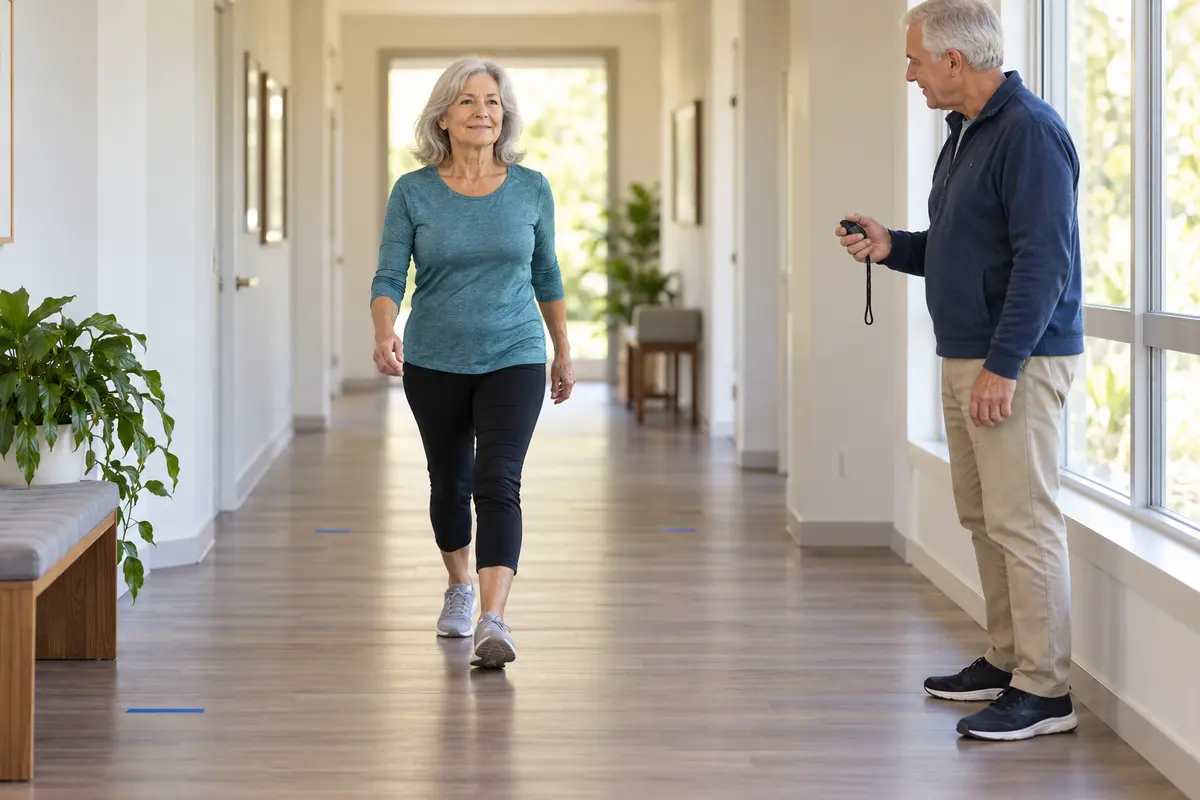
How to Measure a Comfortable 4-Meter Walk
Only try this when walking is already safe, and use a helper rather than timing yourself.
- Mark a straight six-meter path on a flat, clear surface.
- Use the first meter to reach your normal pace.
- Time the central four-meter section.
- Use the final meter to slow down naturally.
- Wear your normal shoes and use your usual walking aid.
- Walk at a comfortable everyday pace—not as fast as possible.
- Divide four by the number of timed seconds.
- If it is safe, rest briefly and repeat the measurement.
The helper should begin timing at the first footfall after the start of the timed section and stop at the first footfall after the four-meter mark. When you repeat the test later, use the same path, instructions, footwear, aid, and timing method.
Why One Result Should Not Alarm You
A slower result can reflect pain, poor sleep, fatigue, recent illness, medication effects, balance concerns, or simply an unfamiliar test. A four-meter hallway walk also does not measure endurance, obstacle avoidance, uneven-ground walking, or every part of real-life mobility.
Research from the NIH Toolbox found that four-meter speed varies with age and sex and that test-retest reliability is limited. Small changes can be measurement noise rather than a meaningful physical decline. See the NIH Toolbox research.
Look for a clear or continuing pattern, especially when it appears alongside:
- A recent fall or near-fall
- New pain, dizziness, or weakness
- Unusual breathlessness
- Greater difficulty with stairs, shopping, bathing, or dressing
- A noticeable change in confidence or walking stability
Those changes deserve a conversation with a qualified healthcare professional.
Train Mobility, Not the Test
The responsible goal is not to rehearse a four-meter test until the number improves. Build the physical abilities that support safe, confident movement.
Public-health guidance for older adults includes aerobic activity, muscle-strengthening activity at least twice per week, and balance work. A practical plan might combine comfortable walking, sit-to-stands, step-ups or another appropriate leg exercise, supported balance practice, and gradual increases in time or distance.
Walking is valuable, but it does not train every part of strength, balance, and fall prevention. People with repeated falls, marked unsteadiness, significant pain, or a recent change in walking may benefit from individualized evaluation by a clinician or physical therapist.
Coach Bob’s Takeaway
Walking speed is best viewed as one piece of information about real-world function. It is not a contest and it is not a crystal ball. Measure consistently, pay attention to meaningful changes, and build the strength, balance, and endurance that help you move through daily life with confidence.
For help creating a joint-conscious plan around your current ability, book a free 20-minute strategy session.
This article is for general education and is not medical advice. Do not perform a home walking test if walking feels unsafe. Seek professional guidance for falls, unsteadiness, dizziness, new weakness, pain, or other concerning symptoms.