
The Bottom Line First
The question sounds simple: can you stand on one leg for ten seconds? A widely discussed 2022 study found that adults who could not complete a standardized one-legged stance had a higher risk of death during follow-up than those who completed it.
That does not mean the test can predict how long you will live. It does not prove that poor balance caused the deaths, and practicing until you pass has not been shown to extend life. The useful message is more modest: balance is one part of overall function, and difficulty with a brief stance may be worth exploring safely.
Podcast companion: This article expands on the Over 50 Fit Life Podcast discussion of the ten-second stance, balance training, and fall prevention.
What the 2022 Study Actually Found
Researchers followed 1,702 adults ages 51–75 who attended an exercise-medicine clinic in Brazil. About 68% were men, and roughly one in five participants could not complete the test.
During a median follow-up of seven years, 7.2% of the overall group died. Death occurred in 17.5% of participants who could not complete the stance and 4.6% of those who completed it. After adjustment for age, sex, BMI, and medical conditions, inability to complete the stance remained associated with a higher hazard of death. Read the study.
Those percentages describe two groups in one observational cohort. They are not a personal probability for you.
Association Is Not Cause and Effect
Balance draws on many systems, including leg strength, vision, sensation, the inner ear, coordination, joint comfort, reaction time, and confidence. Medical conditions and medication effects can influence it as well.
Some of those same factors can affect overall health. That means balance difficulty may be a marker of a broader issue rather than a direct cause of mortality. The study did not show that failing the stance caused death or that improving the score would change survival.
Important Limits of the Headline
The participants were clinic volunteers, not a representative sample of every adult over 50. They were fully ambulatory, and people with unstable gait or signs of an acute vestibular or neurological problem were excluded. A physician or nurse supervised the test face to face.
The test also measures one brief static-balance task. It does not fully assess:
- Walking and changing direction
- Lower-body strength and power
- Vision or sensation
- Medication effects
- Reactions to a trip or slip
- Balance on uneven ground
- Overall fall risk
The study examined mortality—not whether failing the test predicted future falls.
Safety Comes Before Curiosity
Do not attempt an unsupervised one-leg test if you:
- Feel unsteady or unsafe on two feet
- Have dizziness or vertigo
- Recently fell
- Have new weakness or numbness
- Are injured or acutely ill
- Need support for ordinary standing
In those situations, a clinician or physical therapist can provide a more appropriate supervised assessment.
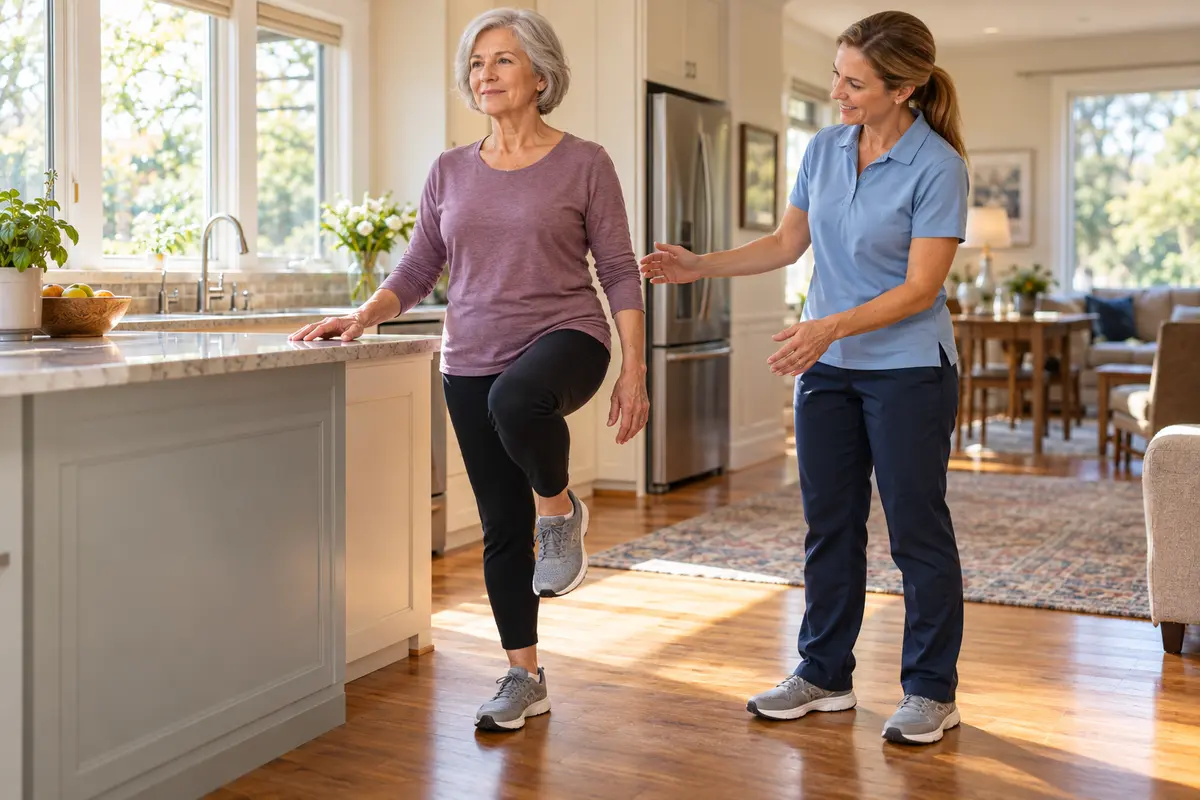
Even if you are normally steady, practice near a sturdy counter or rail with another person nearby. The objective is not to prove anything by refusing support.
A Safer Training Version
Training balance is different from recreating the research test. Try this only when balance activity is appropriate for you:
- Stand beside a stable counter with both feet planted.
- Keep one or both hands on the counter initially.
- Shift your weight gradually onto one leg.
- Lighten your hand support only as control allows.
- Lift the other foot a small distance if you remain steady.
- Hold briefly while breathing normally, then switch sides.
- Stop for dizziness, pain, new symptoms, or loss of control.
Progress might mean using slightly less hand support, holding for a few more seconds, or practicing a controlled weight shift. It does not have to mean chasing ten seconds immediately.
Balance Training Is Bigger Than One-Leg Standing
A Cochrane review of 39 studies involving 7,920 community-dwelling older adults found that balance and functional exercise reduced the rate of falls by 24%. Review the evidence.
A useful program can include:
- Supported weight shifts
- Stepping forward, sideways, and backward
- Heel-to-toe walking near support
- Sit-to-stands
- Appropriate lower-body strengthening
- Supported one-leg standing
World Health Organization guidance recommends varied multicomponent activity emphasizing functional balance and strength on three or more days per week for adults 65 and older, adapted to ability. Read the WHO guidelines.
Tai Ji Quan is another evidence-based option, but it is not a guarantee or requirement. In a randomized trial involving 670 adults aged 70 or older at high risk of falling, a tailored 24-week therapeutic Tai Ji Quan program produced fewer falls than stretching and a multimodal exercise program. Those results belong to that specific structured intervention, not automatically to every class or unsupervised routine. Read the trial.
When a Fuller Assessment Makes Sense
The U.S. Preventive Services Task Force recommends exercise interventions for community-dwelling adults 65 and older who are at increased risk of falling. Decisions about broader multifactorial care should consider prior falls, medical conditions, preferences, and personal circumstances. Review the recommendation.
Seek professional guidance when balance changes suddenly, falls are recurring, dizziness is present, or weakness, numbness, vision changes, or medication effects may be involved.
Coach Bob’s Takeaway
The ten-second stance is not a lifespan test. It is one small window into balance and function. Use support, build strength and stepping ability, and treat a concerning change as a reason to get better information—not as a frightening verdict.
For help developing a safe, progressive fitness plan, book a free 20-minute strategy session.
This article is for general education and is not medical advice. People with unsteadiness, dizziness, recent falls, new neurological symptoms, injury, or unsafe standing should seek supervised professional assessment rather than attempting a home test.