The Bottom Line First
Perimenopause can change sleep, recovery, energy, and how training feels—but it does not make productive exercise impossible. The most useful plan is not endless cardio or a rigid calendar built around predicted hormone phases. It is a repeatable combination of progressive strength training, some appropriately scaled higher-intensity work, enough food to recover, and adjustments based on your actual symptoms and readiness.
Exercise physiologist Dr. Stacy Sims summarizes the mindset well: “You are not broken. You’re not doing anything wrong. You’re just in a different physiological state.” Her practical message is to keep the training stimulus meaningful while respecting recovery.
That does not mean every woman needs barbell maxes, sprinting, or a very-high-protein diet. The details should match your training history, bone health, joints, cardiovascular risk, symptoms, and preferences.
What Changes During Perimenopause?
Perimenopause is the transition leading to menopause. Estrogen and progesterone can fluctuate substantially, and symptoms may change from week to week. Sleep disruption, hot flashes, mood changes, heavier or irregular bleeding, and altered energy can all affect training.
Postmenopause begins after 12 consecutive months without a menstrual period. Hormones are generally lower and more stable, but the loss of estrogen’s protective effects can matter for bone, muscle, and cardiometabolic health.
The practical difference is not that one phase requires an entirely different exercise universe. Perimenopause may require more day-to-day flexibility; postmenopause may require greater attention to recovery and maintaining a strong enough stimulus.
If symptoms are severe, bleeding changes suddenly, or fatigue feels out of proportion to your routine, speak with a clinician. Iron deficiency, thyroid problems, sleep disorders, medication effects, and other conditions can overlap with what people casually label “just menopause.”
Priority One: Build and Protect Strength
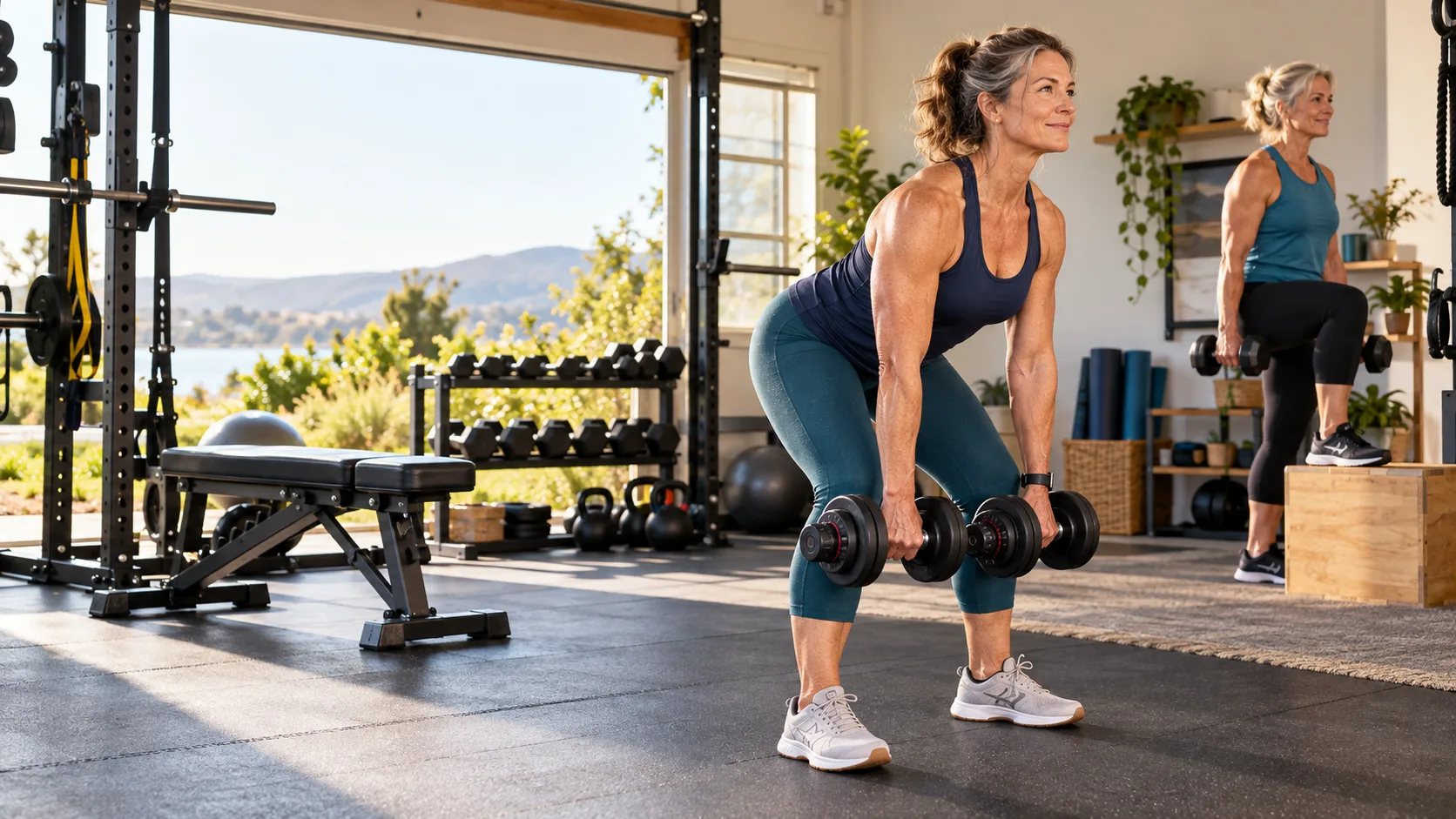
Sims recommends making resistance training central during and after the menopause transition. The broader evidence supports progressive resistance exercise for maintaining strength, physical function, and bone health.
“Heavy” should be understood relative to the person—not as a specific dumbbell weight. A productive set is one that is challenging near the end while technique remains controlled. For an experienced lifter, that may eventually mean sets of three to six repetitions. For a beginner, the correct starting load may allow eight to twelve smooth repetitions while learning the movement.
Useful patterns include:
- A squat or chair-stand variation
- A hip hinge or deadlift variation
- A row or pulldown
- A push-up, chest press, or shoulder-friendly press
- A carry, step-up, or split-stance exercise
- Trunk and balance work matched to your ability
Start with two full-body sessions per week. Use one to three work sets for each major movement, stop before technique breaks down, and progress one variable at a time.
What the Bone Research Really Shows
The LIFTMOR randomized trial studied 101 postmenopausal women with low bone mass. The intervention group completed supervised, twice-weekly sessions for eight months using five sets of five repetitions at more than 85% of one-repetition maximum, plus impact work.
Compared with a low-intensity home program, the supervised group improved lumbar-spine bone mineral density and several measures of physical function. Only one minor training-related adverse event was reported.
This is encouraging evidence—not permission to copy the program alone at home. Participants were screened, the training was highly supervised, and the sample consisted of otherwise healthy women. If you have osteoporosis, a previous fragility fracture, significant balance problems, or substantial spinal or joint symptoms, get individualized guidance before adding heavy or impact loading.
Bone-focused training may eventually include carefully selected jumps, hops, or multidirectional impact, but impact is not appropriate for everyone. Progressive resistance, balance practice, and safe weight-bearing activity remain useful places to begin.
Zone 2 Is Useful—But It Is Not the Whole Plan
Walking and easier aerobic work can support cardiovascular health, recovery, social connection, and overall activity. You do not need to stop doing them.
The more accurate question is whether low-to-moderate steady exercise should be your only training stimulus.
A large systematic review and meta-regression combined hundreds of exercise studies. After accounting for factors such as training frequency and program length, steady endurance training, high-intensity training, and sprint-interval training increased mitochondrial content by similar percentages. Higher intensities were more efficient per hour, while greater training frequency and volume also mattered.
In plain language: steady cardio works, and intensity can deliver more adaptation per minute. One does not have to replace the other.
For someone already active and medically cleared, one weekly interval session is a sensible starting point:
- Warm up gradually for 8 to 10 minutes.
- Perform four to six harder efforts lasting 30 to 90 seconds.
- Recover easily for at least as long as the hard effort.
- Finish with several easy minutes.
“Hard” does not have to mean all-out. A stationary bike, incline walk, rowing machine, pool, or low-impact circuit may be more appropriate than running sprints. If you have a heart condition, fainting history, uncontrolled blood pressure, or have been inactive, ask your healthcare professional how to begin.
Eat Like You Are Building Something
Training is the stimulus. Food supplies the energy and raw materials for recovery.
Low energy availability means too little dietary energy remains after exercise to support normal physiological functions. Research in female athletes links problematic low energy availability with changes in reproductive and metabolic hormones, bone health, and performance. Direct evidence specific to active midlife women is still limited, so it should not be used to claim that every perimenopause symptom comes from under-eating.
Warning signs worth discussing with a qualified professional include persistent fatigue, declining performance, repeated injuries, significant unintended weight loss, obsessive food or exercise behaviors, or menstrual disruption beyond expected transition changes.
Protein: useful, but more is not automatically better
Sims often recommends protein targets near 1 gram per pound of body weight—about 2.2 grams per kilogram. That is higher than many consensus recommendations and should be presented as her preferred target, not a universal requirement.
A 2018 meta-analysis of resistance-training studies estimated that gains in fat-free mass generally stopped increasing beyond roughly 1.6 g/kg/day, although the confidence interval was wider. Guidance for healthy older adults often starts around 1.0 to 1.2 g/kg/day, with higher intakes sometimes considered for active people or during illness and recovery.
The practical approach is to include a useful protein source at each meal—such as fish, poultry, eggs, yogurt, cottage cheese, tofu, tempeh, beans, or lentils—rather than forcing an extreme target. Read How Much Protein Do You Need After 50? for a fuller explanation.
If you have kidney disease, liver disease, or medical dietary restrictions, ask your clinician or registered dietitian before raising protein intake.
Do not fear all carbohydrates
Carbohydrates can support higher-intensity training and recovery. Fruit, vegetables, beans, whole grains, and starchy foods around demanding sessions can fit a health-supporting pattern.
You also do not have to eat a large meal immediately before training. If exercising after a long gap without food leaves you flat, try a small, familiar protein-and-carbohydrate snack: yogurt and fruit, half a banana with milk, or a small portion of oats. The goal is better training and recovery—not obeying a rigid meal-timing rule.
Fasting may suit some inactive people or some people managing metabolic disease under professional guidance. It is not automatically the best tool for an active woman who is already struggling to eat enough.
Train by Readiness, Not a Generic Cycle Calendar
The current evidence does not support universal workout templates tied to predicted menstrual-cycle phases. A 2025 expert statement from the Chartered Association of Sport and Exercise Sciences reports no consistent menstrual-phase effect on acute strength or resistance-training adaptations and recommends individualized symptom management.
Your symptoms still matter. The point is to respond to your own pattern instead of assuming every woman performs the same way on the same cycle day.
Before training, rate four areas from 1 to 5:
| Readiness check | What to notice |
|---|---|
| Sleep | Rested, interrupted, or severely shortened? |
| Energy | Normal, flat, or unusually depleted? |
| Soreness and pain | Ordinary muscle soreness or a joint/soft-tissue warning? |
| Motivation and focus | Ready to work or struggling to coordinate and concentrate? |
Mostly normal scores: follow the plan. Several low scores: keep the appointment but reduce load or sets, practice technique, walk, or perform an easier mobility session. Persistent low scores: look beyond willpower and address sleep, food intake, stress, symptoms, and medical issues.
A Practical Midlife Training Week
This is Coach Bob’s example—not Dr. Sims’s program and not a medical prescription.
| Day | Training focus |
|---|---|
| Monday | Full-body strength, about 30–45 minutes |
| Tuesday | Easy walk or other comfortable aerobic activity |
| Wednesday | Short, scaled interval session plus mobility |
| Thursday | Recovery, everyday movement, or rest |
| Friday | Full-body strength, about 30–45 minutes |
| Saturday | Enjoyable longer walk, bike ride, swim, or recreation |
| Sunday | Rest or gentle movement; review readiness for the next week |
If that is too much, start with two strength sessions and regular walking. If you are already well trained, the plan can expand—but more volume is useful only when you can recover from it.
Start Where You Are
| Current starting point | Best next step |
|---|---|
| Mostly sedentary | Walk, garden, practice chair stands, and build a regular movement habit |
| Lightly active | Add one structured strength session, then progress toward two |
| Consistently active | Use two strength days and introduce one scaled interval session |
| Experienced athlete | Periodize hard work, monitor recovery, and schedule easier weeks |
You do not have to jump from walking to heavy barbells and all-out sprints. Strength and fitness are built through progression. Tendons, bones, technique, and confidence need time to adapt.
Frequently Asked Questions
Will lifting heavy make me bulky?
Building substantial muscle is difficult, especially without years of consistent training and adequate food. Progressive lifting is far more likely to improve strength, function, and body composition gradually than to create sudden unwanted size.
Is walking still worthwhile during perimenopause?
Absolutely. Walking supports health and activity. It simply does not replace every benefit of progressive resistance training, balance work, or appropriately scaled intensity.
Should I stop intermittent fasting?
Not solely because of an article. Consider whether it helps or interferes with energy, training quality, recovery, and adequate food intake. Discuss it with a healthcare professional if you have metabolic disease, an eating-disorder history, or concerning symptoms.
Do I need to train around my menstrual cycle?
Not according to a generic phase chart. Track your own symptoms, sleep, recovery, and performance, then adjust when a pattern is clear.
What if I have osteoporosis?
Resistance and impact training may be useful, but exercise selection and progression should reflect fracture history, bone density, balance, symptoms, and medical guidance. The LIFTMOR protocol was supervised and should not be copied without appropriate screening and coaching.
Coach Bob’s Takeaway
Midlife is not the time to punish your body with more exercise and less food. It is the time to make the training more purposeful.
Build strength twice a week. Keep the walks you enjoy. Add a small dose of intensity when you are ready. Eat enough to support the work, and use your actual recovery—not internet rules—to guide adjustments.
If you want help turning those principles into a joint-conscious routine, explore Stronger After 50: the 4-Week Restart. It provides three manageable weekly sessions and personal check-ins built around your starting point. For practical meal planning, learn about NutriPlanPro 50+.
This article is for general education and is not medical advice. Speak with your healthcare professional before beginning heavy, high-intensity, or impact exercise—especially if you have heart disease, a pacemaker or rhythm condition, osteoporosis, a previous fracture, kidney disease, significant joint problems, or have been inactive. Medication, hormone therapy, supplement, and eating-disorder decisions require individualized professional care.