
The Bottom Line First
Golf and pickleball after 50 require more than flexibility. You need enough hip and upper-back motion, trunk control, leg strength, balance, and the ability to slow down after producing force. Train those pieces gradually instead of repeatedly forcing the lower back to create every degree of rotation.
That does not mean the lumbar spine should never move. It means your swing or stroke is usually better served when rotation is shared across the feet, hips, trunk, and upper back—and when you can control the start and finish.
Why Rotation Can Feel Different After 50
Stiff hips, limited upper-back motion, fatigue, old injuries, and a rushed warm-up can all change how your body rotates. If the hips and feet stay planted while the shoulders turn aggressively, the lower back may take more of the motion and stress than it comfortably tolerates.
The solution is not to stretch harder without a plan. First identify which movement is limited and which position causes symptoms. Then combine comfortable mobility with strength and coordination.
Court and course sports also involve deceleration. Reaching a ball, changing direction, or finishing a swing requires you to absorb force and regain balance. That is why leg strength, stepping practice, and anti-rotation exercises belong beside mobility work.
Anti-Rotation Is Control Training
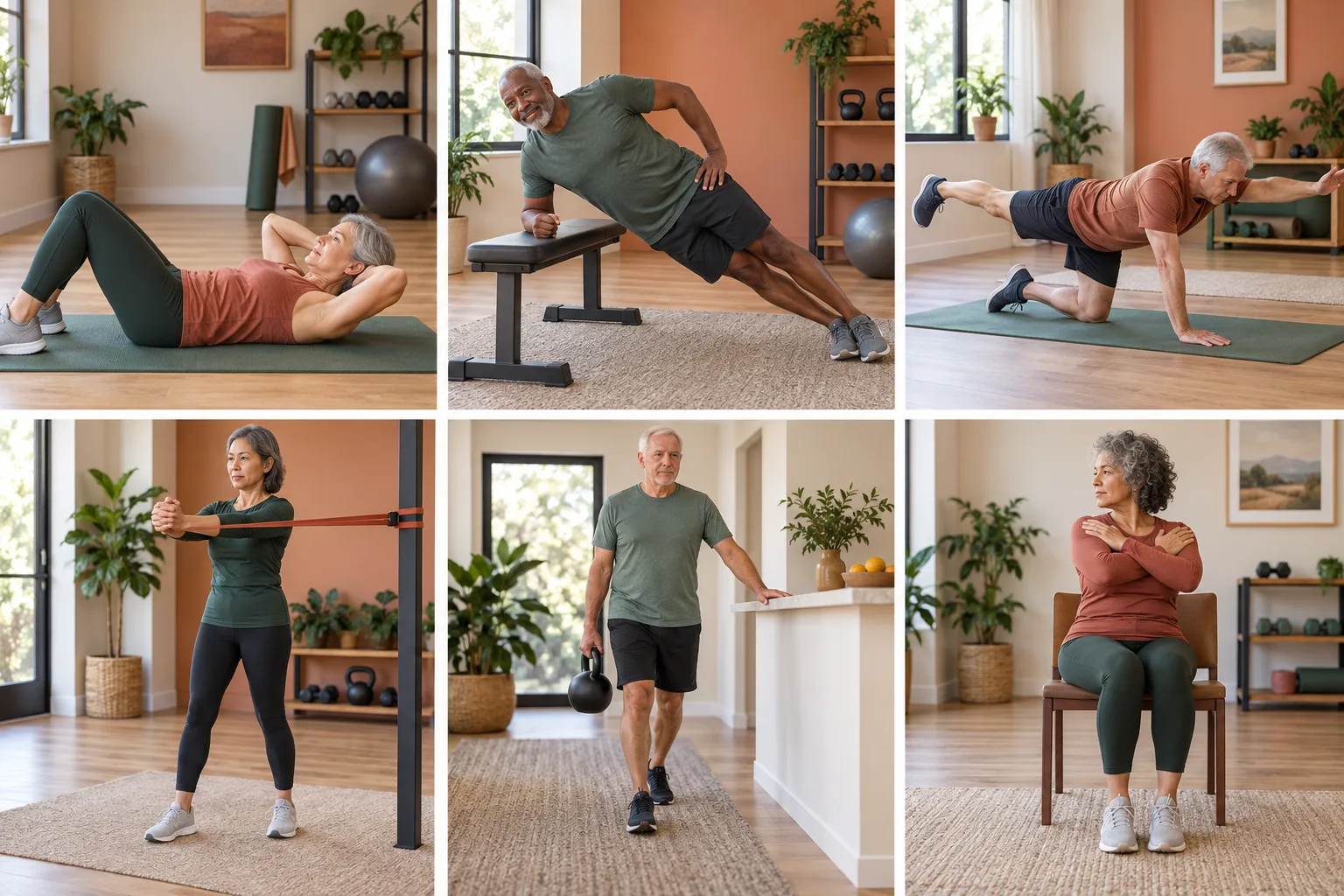
The Pallof press is often described as an “anti-rotation” exercise. A band or cable pulls from the side while you press your hands away from your chest. Your job is to keep the torso controlled rather than allowing the resistance to turn you.
This can train the trunk to manage rotational force, but it does not “lock” or bulletproof the spine. Research on core training supports using multiple movement categories rather than treating one exercise as the answer to every back or performance problem. A recent review describes anti-extension, anti-rotation, and anti-lateral-flexion work as complementary parts of training. Review the research.
Pallof Press Setup
- Anchor a band securely at chest height.
- Stand sideways to the anchor with your feet in a stable stance.
- Hold the band at your chest and step away until there is light tension.
- Exhale gently as you press forward without letting your body turn.
- Return slowly and complete 6–10 repetitions before switching sides.
Use a split stance or move closer to the anchor if balance or back comfort changes.
Build Rotation Where You Can Control It
Try this sequence before a practice session:
1. Supported Hip Turn
Hold a counter or club for support. Let one heel lift as the pelvis turns a small amount, then return. Practice five slow repetitions per side. This teaches the foot and hip to participate instead of pinning both feet to the floor.
2. Seated Upper-Back Rotation
Sit tall with arms crossed. Turn through a comfortable range while keeping the movement smooth. Do not yank on the chair or force an endpoint. Complete five repetitions per side.
3. Step-and-Turn
Take a small diagonal step, allow the hips and torso to turn together, pause in balance, and return. Begin slowly near a support. This connects rotation with the footwork used in real activity.
4. Pallof Press
Perform one or two sets of 6–10 controlled repetitions per side. Keep breathing; do not turn the set into an all-out brace.
5. Suitcase Carry
Carry a dumbbell or kettlebell on one side for 20–30 seconds. Stay tall and avoid leaning. Complete one or two rounds per side. Carries train trunk control, grip, and gait together.
Add Power Only After Control Is Reliable
Power means producing force promptly. It does not mean moving recklessly. Once basic strength, stepping, and symptom control are reliable, you can add faster intent to safe movements.
Options include a purposeful chair stand, a light medicine-ball chest pass to a sturdy wall when space and health allow, or a slightly quicker step-and-turn that still finishes in balance. Start with low volume and full recovery.
Landmine rotations are another option, but they are commonly performed poorly. Moving a heavy bar in a large arc while the hips remain fixed can simply relocate stress. If you use them, keep the load light, let the feet and hips turn, and work within a range you control. A landmine press or Pallof press is a more accessible starting point for many people.
A Twice-Weekly Court-and-Course Plan
| Exercise | Sets × repetitions | Primary purpose |
|---|---|---|
| Supported split squat or sit-to-stand | 2 × 6–10 | Leg strength and deceleration |
| Supported step-and-turn | 2 × 5 per side | Footwork and coordinated rotation |
| Pallof press | 2 × 6–10 per side | Rotational control |
| Supported row | 2 × 8–12 | Upper-back strength |
| Suitcase carry | 2 × 20–30 seconds per side | Grip, gait, and trunk control |
| Calf raise near support | 2 × 10–15 | Ankle strength and push-off |
Leave at least a day between these sessions at first. On sport days, use a shorter warm-up version rather than completing the full strength workout immediately before you play.
Know When to Get Help
Stop and seek appropriate care for sharp or spreading pain, numbness, new weakness, dizziness, chest pain, or a loss of balance you cannot control. If a golf swing or pickleball stroke repeatedly causes pain, a physical therapist or qualified sports-medicine professional can help assess the specific movement.
Coach Bob’s Takeaway
Rotational sports are not automatically bad for your back. They are skills that benefit from preparation. Build leg strength, let the hips and feet contribute, practice controlled rotation, and train your trunk to manage force in more than one direction.
Start with the free 21-Day Stronger Back Challenge, then use the final week’s rotation and stepping work as your bridge back to the court or course. For a plan fitted to your experience and limitations, book a free 20-minute strategy session.
This article is for general education and is not medical advice. Exercise should be adapted to your health, symptoms, medications, and abilities.