Build trunk control, balance, and confidence in about 10–15 minutes. This is a gradual practice plan—not a promise to cure pain or make your back “bulletproof.”
Print the page or save it as a PDF to mark each day.
Three challenge rules
Use only a range and resistance you can control.
Change one variable at a time.
Judge the session by how you feel during it and over the next 24–48 hours.
Your six movements
Control first. Progress second.
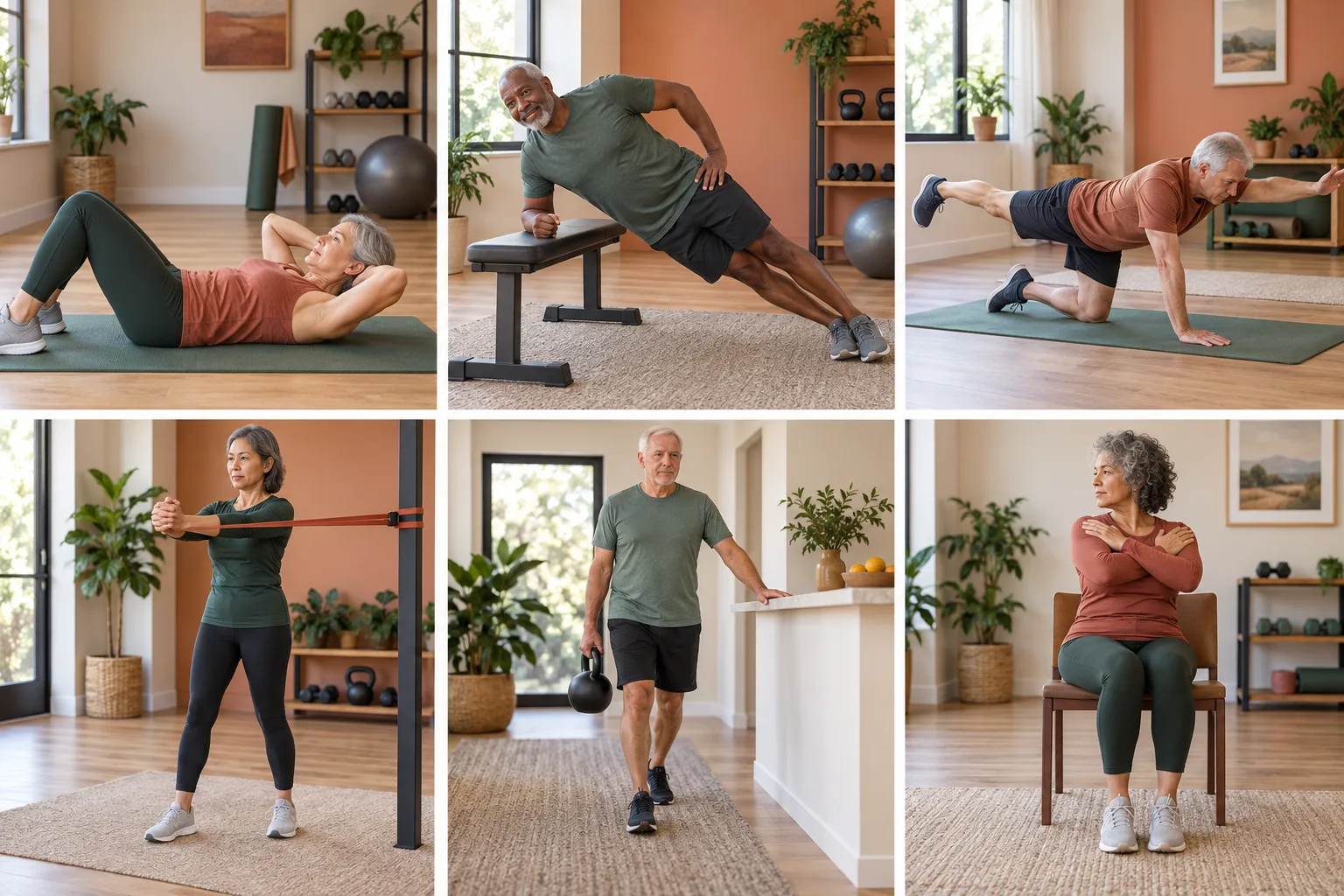
The images show the six movement categories. Use the written setup and easier option below to fit each one to your current ability.
Left to right: modified curl-up, elevated side plank, bird dog, Pallof press, supported suitcase carry, and seated upper-back rotation.
1
Modified curl-up
3–5 holds of 5–10 seconds
Setup
Lie on your back with one knee bent and the other leg comfortable. Support the natural low-back curve with your hands if helpful.
Move
Gently brace, lift the head and shoulders only a small distance, pause, then lower with control. Keep the neck relaxed.
Easier option: Brace without lifting, or reduce the lift until it feels controlled.
2
Elevated side plank
2 holds of 10–20 seconds per side
Setup
Place your forearm on a sturdy counter or bench and step your feet away until your body forms a comfortable line.
Move
Press the forearm into the surface, keep the hips gently lifted, and breathe normally without twisting.
Easier option: Use a wall or a higher surface and shorten the hold.
3
Bird dog
4–6 controlled repetitions per side
Setup
Begin on hands and knees with hands under shoulders and knees under hips.
Move
Brace gently. Extend one leg and, when stable, the opposite arm. Pause without arching or turning, then return slowly.
Easier option: Move one limb at a time or slide the toes along the floor.
4
Pallof press
6–10 repetitions per side
Setup
Stand sideways to a securely anchored band at chest height. Hold it close to your chest with a stable stance.
Move
Press the hands forward while resisting the band’s pull. Pause, breathe, and return slowly.
Easier option: Move closer to the anchor, use a lighter band, or use a split stance.
5
Supported suitcase carry
2 walks of 20–30 seconds per side
Setup
Hold a manageable dumbbell or kettlebell at one side. Keep your free hand near a stable counter or rail.
Move
Walk with quiet steps, level shoulders, and an upright posture. Set the weight down safely before switching sides.
Easier option: Use less weight, shorten the walk, or march in place beside support.
6
Seated upper-back rotation
5 slow repetitions per side
Setup
Sit tall in a stable chair with feet planted and arms crossed over your chest.
Move
Turn smoothly through a comfortable range, pause, and return. Do not force the endpoint or pull on the chair.
Easier option: Use a smaller range and keep the movement slow.
Your 21-day tracker
Practice, recover, then build
On practice days, choose three or four movements. On recovery days, take an easy walk or do comfortable mobility. Progress only one exercise at a time.
How the weeks change
Small progress you can repeat
Do not add resistance, range, repetitions, and session length all at once. Your goal is a more capable next week—not one heroic day.
Week 1: Learn positions and find the easiest version that creates muscular effort without worsening symptoms.
Week 2: Add one repetition or about five seconds to one exercise while keeping the others unchanged.
Week 3: Use four to six movements and connect them to walking, carrying, turning, golf, pickleball, and daily life.
Keep learning
Understand the plan before you begin
Read the research-based core guide, or book time with Coach Bob to discuss a plan based on your history, equipment, and goals.