The Bottom Line First
Strength training after 50 is about more than building visible muscle. An American Heart Association scientific statement says resistance training can improve or maintain muscle mass and strength and can have favorable effects on cardiovascular disease and its risk factors. A steady, appropriately scaled program can support both everyday function and long-term health.
Why Does the American Heart Association Call Out Strength Training?
Dr. Stacy Sims recently highlighted the American Heart Association’s scientific statement on resistance exercise. The statement, published in Circulation, is the first major AHA update on this topic since 2007. Its central message is clear: “Resistance training not only can improve or maintain muscle mass and strength, but also has favorable … effects on cardiovascular disease and risk factors.”
That is the AHA’s summary, not a promise that lifting prevents or treats heart disease. The statement reviews evidence in adults with and without cardiovascular disease and describes resistance training as one useful part of a broader health plan.
How Can Lifting Support Cardiovascular Health?
Resistance training challenges muscles against an external load or body weight. That can mean dumbbells, machines, resistance bands, or controlled body-weight exercises. The AHA statement summarizes evidence that this kind of training can improve several cardiovascular risk factors, including resting blood pressure, blood sugar regulation, blood lipids, and body composition.
The statement also reports that resistance training improves insulin sensitivity and is associated in research with lower diabetes incidence. Some research summarized by the AHA links participation in resistance training with lower rates of cardiovascular events and mortality. Those mortality findings are largely observational: they show a relationship, but they cannot prove that lifting alone caused the difference. People who strength train may also differ in other health habits.
The practical point is still useful. Heart health is shaped by several behaviors. Aerobic activity, strength work, sleep, nutrition, not smoking, and appropriate medical care each have a role. Strength training deserves a place alongside cardio rather than being treated as a vanity project.
Does Strength Training Replace Walking or Aerobic Exercise?
No. Current U.S. activity guidance recommends at least 150 minutes of moderate-intensity aerobic activity each week for most adults, along with muscle-strengthening activity on at least two days. The two forms of exercise train overlapping but different capacities.
Walking, cycling, swimming, and other aerobic activities help build cardiorespiratory fitness. Strength work gives muscles a progressive challenge that ordinary daily activity may not provide. You do not have to choose one. If you already walk most days, adding two brief full-body strength sessions is a sensible next step.
The AHA statement also reviews evidence that combining aerobic and resistance exercise may improve certain risk factors more than either mode alone. That does not require a complicated schedule. A week can be as simple as several walks and two manageable strength sessions.
Why Is This Especially Relevant for Women After 50?
Muscle and bone are part of health, not just appearance. During and after the menopause transition, many women are particularly focused on maintaining strength, power, and bone density. Resistance training can improve muscular strength and endurance in women of all ages. The AHA statement also reports improvements in bone mineral density at the femoral neck and lumbar spine in pre- and postmenopausal women. Combining resistance exercise with other appropriate weight-bearing activity may offer additional bone-health benefits.
Stacy Sims has also emphasized that women’s training responses are not identical to men’s or to one another’s. Some women may tolerate more repetitions or recover differently between sets, but there is no need to force a workout based on a rigid cycle calendar. Pay attention to symptoms, sleep, energy, joint response, and recovery. Adjusting a session is training intelligently, not failing.
How Should You Start Strength Training After 50?
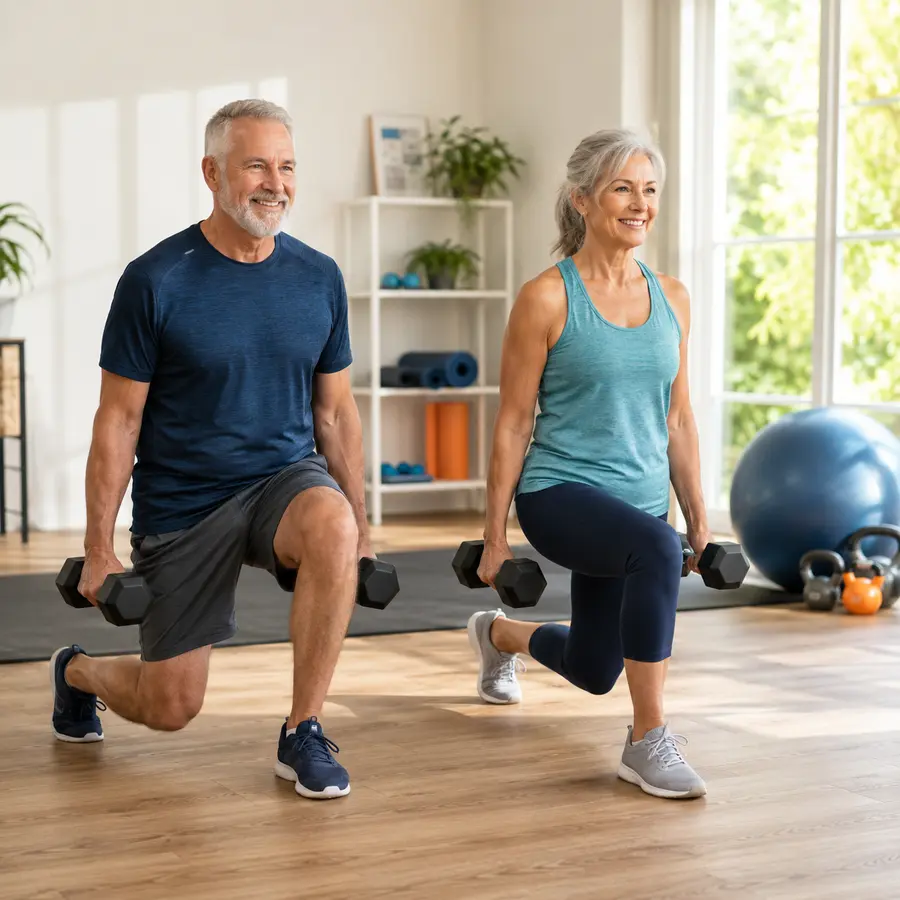
The best starting point is a version you can control and repeat. The AHA describes a general approach for healthy adults that works major muscle groups at least twice weekly. A session can use machines, free weights, bands, or body weight. For someone new to training, start with a comfortable load and learn the movement before adding more.
Try building around these patterns:
- Sit-to-stand or a supported squat for thighs and hips
- A band or machine row for the back and arms
- A wall or elevated push-up for the chest, shoulders, and arms
- A light hip hinge for the hips and back of the legs
- A supported carry or calf raise for grip, trunk, and lower-leg strength
Choose a range and resistance that let you breathe normally and keep good control. When the exercise feels steady for several sessions, progress gradually by adding a little resistance, a repetition, or a set. You do not need to increase everything at once.
What Does “Joint-Friendly” Progress Look Like?
Joint-friendly does not mean effortless. It means the challenge is scaled to your current ability, your technique stays controlled, and symptoms do not keep escalating. You might begin with a higher chair, a wall push-up instead of a floor push-up, a light band, or a smaller range of motion. Those are legitimate training choices.
For people with a heart condition, uncontrolled blood pressure, recent surgery, a significant injury, or exercise-related chest discomfort, ask a clinician how to begin. Stop and seek appropriate medical help for concerning symptoms such as chest pressure, faintness, or unusual shortness of breath. A general article cannot account for your health history or medications.
Coach Bob’s Takeaway
You do not need to become a powerlifter to earn the health benefits of strength training. Start with a couple of simple sessions, practice the movements, and build at a pace your body can recover from. The goal is not to prove how hard you can train today; it is to stay strong enough for the life you want to live.
If you want a practical place to begin, explore our joint-friendly exercise guides or work with Bob to build a plan around your starting point.
Common Questions About Strength Training and Heart Health
Does strength training help heart health?
The American Heart Association says resistance training can have favorable effects on cardiovascular disease and risk factors, including blood pressure, blood sugar regulation, blood lipids, and body composition. It is one part of a broader health plan, not a substitute for medical care or aerobic activity.
How often should adults over 50 strength train?
U.S. activity guidance recommends muscle-strengthening activity at least two days per week for adults. Start with a manageable routine that works major muscle groups and allow recovery between challenging sessions.
Is strength training safe for people with heart disease?
Many people with cardiovascular disease can exercise, but the right activities and intensity depend on the person and their condition. Ask the clinician who knows your history for guidance before starting or changing a program.
Do women after menopause benefit from resistance exercise?
Yes. The AHA statement describes benefits for strength and endurance and reports that resistance training can improve bone mineral density at the femoral neck and lumbar spine in pre- and postmenopausal women. Individual exercise choices should account for bone health, symptoms, experience, and recovery.
This article is for general education and is not medical advice. Talk with your healthcare professional about exercise choices that fit your health, symptoms, and medical history.
Sources
- Paluch AE, et al. Resistance Exercise Training in Individuals With and Without Cardiovascular Disease: 2023 Update: A Scientific Statement From the American Heart Association. Circulation. 2024;149:e217–e231.
- AHA Professional Heart Daily summary of the scientific statement.
- Sims, S. Resistance Training: Getting the Respect It Deserves.
- Sims, S. Women respond differently to resistance training.
- U.S. Department of Health and Human Services. Physical Activity Guidelines for Americans.