
The Bottom Line First
If an overhead press pinches the front or outside of your shoulder, you may not need to abandon shoulder training. Try changing the path: press slightly forward in the shoulder blade’s natural plane, use a neutral grip when possible, lower the load, and keep the range comfortable. Persistent or worsening pain deserves evaluation—not tougher repetitions.
That “pinch” is common, but it does not tell you exactly what structure is responsible. Shoulder discomfort can have several causes, and even the familiar term “impingement” does not always mean tissue is literally being trapped. The practical goal is to find a repeatable pressing pattern that trains the shoulders without steadily aggravating symptoms.
Why a Straight Overhead Press May Feel Uncomfortable
The shoulder is not a simple hinge. The upper-arm bone moves in a shallow socket while the shoulder blade rotates and tilts along the rib cage. The rotator-cuff muscles help keep the upper-arm bone controlled, and the shoulder blade provides a moving base.
Above that joint sits the acromion—the bony roof you can feel near the top of the shoulder. Rotator-cuff tendons and a cushioning bursa occupy the area below it. Pain at the front or outside of the shoulder can appear when the total training stress, exercise path, range, or load exceeds what the area currently tolerates.
A straight-bar press fixes both hands on one bar with the palms facing forward. That position is not automatically harmful, and plenty of adults use it comfortably. But it gives your wrists, elbows, and shoulders fewer options to find their preferred path. If that path repeatedly produces a pinch, changing the angle may be more useful than forcing the same movement with lighter plates.
Hospital for Special Surgery notes that rotator-cuff-related shoulder pain often appears with overhead work and emphasizes controlled shoulder-blade and rotator-cuff strengthening. Its rehabilitation guidance also uses elevation in the scapular plane rather than treating every raise as a straight-out-to-the-side movement. Review HSS’s current shoulder exercise guidance.
The Scapular Plane in Plain Language
Stand with one arm pointing straight ahead. Now move it halfway toward the position it would take if you stretched both arms directly out to your sides. That diagonal lane—roughly 30 to 45 degrees forward of your side—is called the scapular plane.
It generally follows the orientation of the shoulder blade. Many people find pressing or raising the arm in this lane more natural than holding the elbows straight out to the sides. It is not a magic angle and it does not guarantee pain-free motion. Think of it as a useful starting path that leaves room for individual anatomy and comfort.
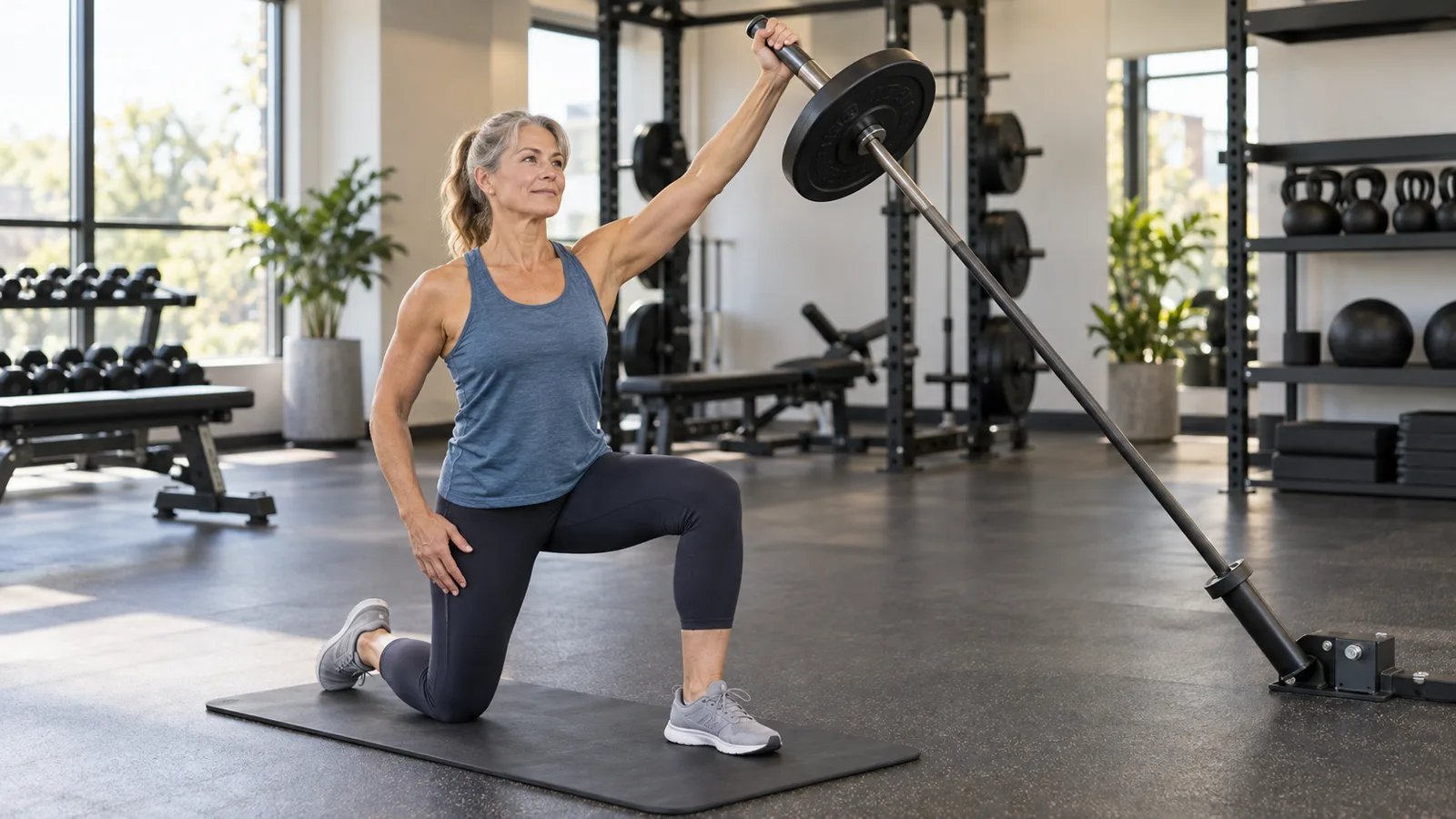
Swap 1: Half-Kneeling Landmine Press
A landmine uses a barbell anchored at one end. Because the free end travels on an arc, you press forward and upward instead of forcing the arm into a completely vertical path.
How to set it up
- Use a proper landmine attachment or secure the bar as your gym instructs. Do not wedge it somewhere unstable.
- Kneel on the knee opposite the working arm. Place the other foot flat in front of you.
- Hold the end of the bar near your shoulder. Keep your wrist stacked rather than bent backward.
- Gently brace your trunk and keep your ribs from flaring upward.
- Press the bar forward and up in a smooth arc. Let your shoulder blade move naturally instead of pinning it down.
- Lower with control and stop the set if the movement becomes painful or unstable.
Start with two sets of 8 to 10 repetitions per side using a load that leaves about three good repetitions available. The half-kneeling position also asks your trunk and hips to resist unwanted twisting. If kneeling is uncomfortable, perform the same press from a split stance or stable standing position.
Swap 2: Neutral-Grip Dumbbell Press
No landmine? Dumbbells let each arm choose its own path. A neutral grip—palms facing each other—with the elbows angled slightly forward may feel more comfortable than a wide, elbows-out position.
How to do it
- Sit against an incline bench or stand with a stable stance.
- Begin with the dumbbells near shoulder level, palms facing each other and elbows slightly forward.
- Keep your forearms close to vertical and your ribs stacked over your pelvis.
- Press upward and slightly inward without banging the dumbbells together.
- Use only the range you can control without a sharp pinch, shrug, or large lower-back arch.
- Lower for about two seconds and keep the movement smooth.
Begin with two sets of 8 to 12 repetitions. If the top half of the motion is uncomfortable, shorten the range temporarily or use a higher incline so the movement becomes more of an angled press. Progress the range or resistance only when the current version remains comfortable during the workout and over the following day.
Try This Shoulder-Friendly Pressing Block
Use this compact sequence once or twice weekly as part of an upper-body session.
| Exercise | Starting dose | What to focus on |
|---|---|---|
| Band external rotation | 1–2 sets of 10–15 | Elbow supported near your side; rotate without twisting your trunk |
| Chest-supported row | 2 sets of 8–12 | Smooth pull; avoid shrugging toward your ears |
| Landmine or neutral-grip press | 2 sets of 8–12 | Comfortable angle, steady ribs, controlled lowering |
This is a starting framework, not a rehabilitation prescription. The support exercises do not “put the shoulder back in place.” They simply train the rotator cuff and shoulder-blade muscles that contribute to controlled pressing.
Form Cues That Matter More Than Chasing Weight
- Let the shoulder blade move. Overhead reaching normally includes upward rotation of the shoulder blade. Do not force it down and back throughout the entire repetition.
- Keep the ribs quiet. A large back arch can make a limited shoulder range look bigger than it is.
- Use a controlled range. More range is useful only when you can own it without sharp pain or major compensation.
- Leave repetitions in reserve. Stop most sets before technique unravels. You do not need muscular failure to learn whether a new path suits your shoulder.
- Judge the next day too. A movement can feel acceptable in the moment but create steadily increasing irritation later.
For a broader strength plan, read Joint-Friendly Hypertrophy After 50 and use the visual exercise guides for additional setup cues and modifications.
When to Stop Experimenting and Get Help
Back off when pain is sharp, worsening, or changes how you move. Seek evaluation from a qualified clinician or physical therapist when pain persists despite reducing the aggravating load, repeatedly wakes you at night, or is accompanied by progressive weakness, numbness, or tingling.
Get prompt medical care when shoulder pain follows a fall or collision, you suddenly cannot raise the arm, or the area becomes substantially swollen, red, or hot. Shoulder or arm discomfort with chest pressure, unusual shortness of breath, sweating, nausea, or dizziness requires urgent medical attention.
Frequently Asked Questions
Is overhead pressing bad for adults over 50?
No. Age alone does not make an exercise unsafe. The right movement depends on your history, symptoms, mobility, technique, load, and recovery. An angled press is simply another way to train the shoulder when a straight-bar version feels poorly tolerated.
Should I press through a shoulder pinch?
Do not treat a sharp or escalating pinch as a requirement for progress. Reduce the load or range, change the pressing path, or stop the exercise. Persistent or unexplained symptoms deserve professional evaluation.
Is a landmine press guaranteed to be pain-free?
No. Its angled path feels better for some people, but no exercise is universally comfortable. Use a manageable range and load, and choose a different movement if symptoms continue.
Can I use one arm at a time?
Yes. A one-arm dumbbell or landmine press can let each shoulder find its own path. Keep the torso controlled and avoid turning the repetition into a whole-body twist.
Coach Bob’s Takeaway
Training after 50 does not mean giving up challenging movements. It means choosing a version that directs the work toward the muscle while respecting the feedback your joints give you.
Change the angle before abandoning the goal. Build the supporting muscles, progress slowly, and keep the movement repeatable.
Want a strength plan built around your current ability and equipment? Explore Stronger After 50: the 4-Week Restart. You can also preview the joint-friendly exercise guides before deciding what support you need.
This article is for general education and is not medical advice. It does not diagnose shoulder pain or replace an examination. If you have persistent shoulder pain, check with your clinician or physical therapist before trying new exercises.