
The Bottom Line First
A small 2026 randomized trial did not show that weekly sirolimus—also called rapamycin—improved the exercise response of sedentary adults ages 65 to 85. Both groups completed the same home program, but the primary analysis found no statistically significant chair-stand advantage with the drug. Two prespecified sensitivity analyses favored placebo, raising the possibility that sirolimus modestly reduced short-term functional improvement.
That is not proof that rapamycin always blocks exercise gains. It is a reason to avoid treating an experimental longevity drug as a shortcut—and never to start, stop, or change a prescription without the clinician managing it.
What the Researchers Tested
The RAPA-EX-01 trial, published in April 2026, enrolled 40 sedentary adults between ages 65 and 85. Their average age was 72.2, and 47.5% were women.
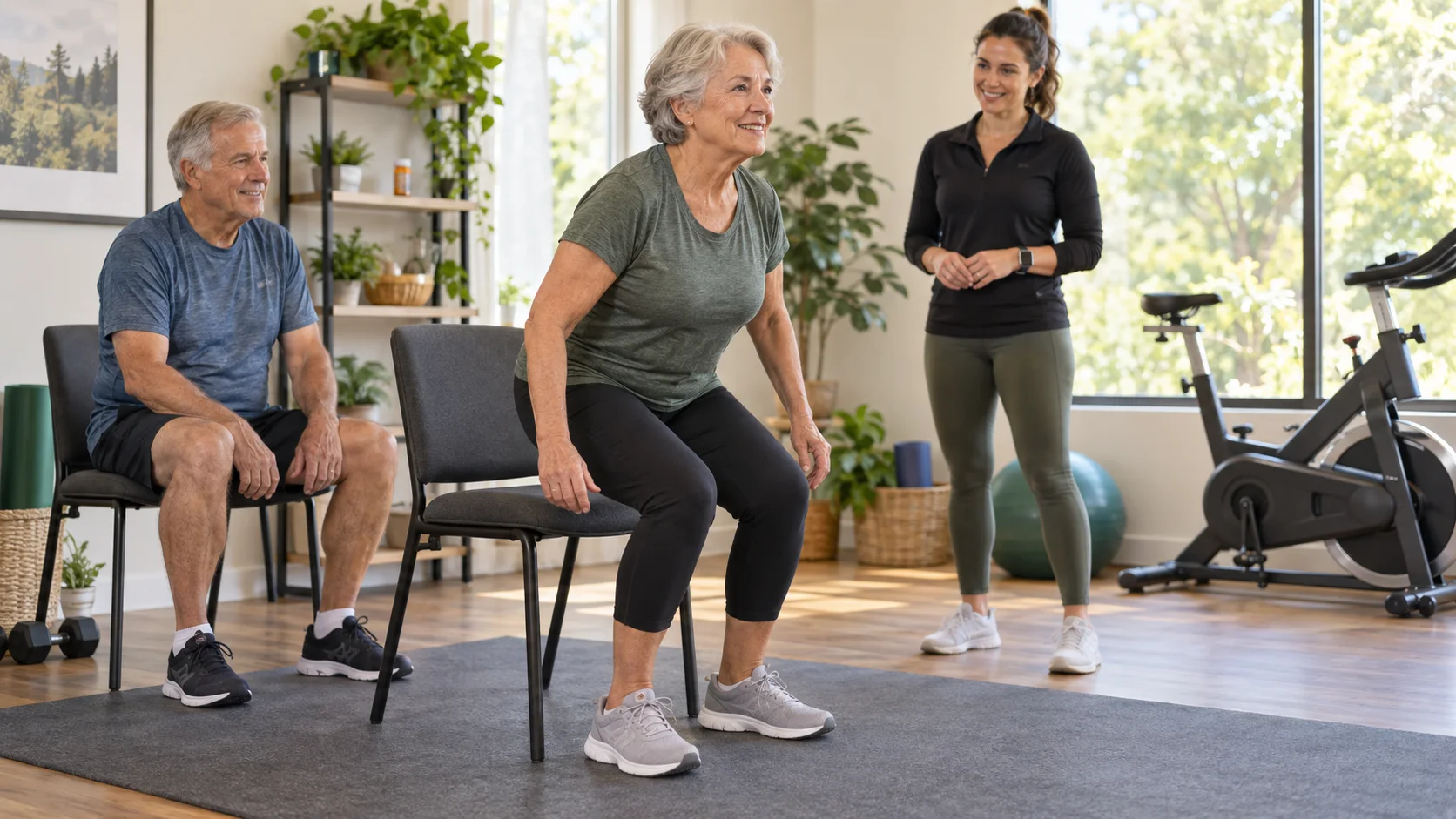
Participants were randomly assigned to receive either 6 milligrams of sirolimus once weekly or a placebo for 13 weeks. Everyone also performed a home-based program three days per week using chair stands and an exercise cycle. The study was double-blind, which means participants and investigators did not know who received the drug during the trial.
The main outcome was change in a 30-second chair-stand test. This test counts how many times a person can rise from a chair in 30 seconds and is commonly used as a practical measure of lower-body function in older adults.
What Happened to Chair-Stand Performance?
In the primary intention-to-treat analysis, the adjusted difference was 2.13 fewer repetitions in the sirolimus group than the placebo group. The 95% confidence interval ranged from 4.61 fewer to 0.34 more repetitions, and the p value was .089.
In plain language: the main analysis did not reach the study's threshold for statistical significance. It therefore did not prove that sirolimus harmed training gains—but it certainly did not show an advantage.
Two prespecified sensitivity analyses painted a more cautionary picture:
| Analysis | Difference for sirolimus vs. placebo | Result |
|---|---|---|
| Primary intention-to-treat | −2.13 repetitions | Not statistically significant |
| Complete-case | −2.46 repetitions | Favored placebo |
| Per-protocol | −3.44 repetitions | Favored placebo |
Sensitivity analyses test whether a finding looks similar when the data are handled in reasonable alternative ways. They matter, but they do not replace the primary result. The fairest summary is that this small trial found no added functional benefit and produced a signal that weekly sirolimus may have attenuated some chair-stand improvement.
Other Measures Did Not Show a Benefit
Researchers also assessed six-minute walking distance, grip strength, and quality of life. None showed a statistically significant advantage for sirolimus.
- Six-minute walking distance: adjusted difference of −4.87 meters, p=.706
- Grip strength: adjusted difference of −1.13 kilograms, p=.344
- Quality-of-life measures: small differences that were not statistically significant
These results are useful because longevity should mean more than a laboratory marker. The ability to stand, walk, grip, carry, and participate in daily life is what makes extra years valuable.
What About Safety?
Seventeen participants in each group reported at least one adverse event, but the total number of reported events was higher with sirolimus: 99 versus 63. One serious case of pneumonia was considered possibly related to the drug.
This was a small, short trial, so it cannot establish long-term safety. Sirolimus is an immunosuppressant used for specific medical conditions—not an over-the-counter longevity supplement. MedlinePlus warns that it can make infections harder to fight and can interact with prescriptions, nonprescription drugs, vitamins, supplements, and herbal products. Grapefruit can also affect how the medication behaves.
If you already take sirolimus for a medical reason, do not change it because of an article or podcast. Discuss exercise, infection risk, vaccinations, surgery, side effects, and all supplements with your prescriber and pharmacist.
Why One Small Trial Cannot Settle the Question
Forty participants and 13 weeks are enough to produce an important early signal, but not a final answer. The findings may not apply to younger adults, trained people, different doses, different schedules, or longer programs. The home exercise plan was also relatively simple.
The authors called for more trials, including work with lower doses. That is the responsible next step. Replication in larger, more diverse groups would help determine whether the chair-stand signal is real, how large it is, and who might be affected.
What Adults Over 50 Can Use Right Now
You do not need to wait for a longevity breakthrough to work on healthspan. Current CDC guidance for adults 65 and older emphasizes a mix of aerobic activity, muscle-strengthening exercise, and balance work. The best starting dose is the one you can perform safely and repeat.
Practical priorities include:
- Train major muscle groups at least twice weekly. Use machines, weights, bands, or bodyweight movements that fit your joints and experience.
- Practice useful patterns. Chair stands, hinges, rows, presses, carries, walking, and supported balance work transfer to daily life.
- Progress gradually. Add a repetition, a little resistance, or a small amount of time—not everything at once.
- Track function, not just appearance. Notice whether stairs, walking, carrying, and getting up feel more capable.
- Review medications and supplements with a professional. “Anti-aging” does not mean interaction-free or risk-free.
For a broader way to evaluate new longevity claims, read Function-First Longevity After 50: What to Track.
Frequently Asked Questions
Did the trial prove rapamycin makes exercise ineffective?
No. The primary result was not statistically significant, and the study was small. It found no exercise advantage from sirolimus and a signal in sensitivity analyses that it may modestly reduce some short-term chair-stand improvement.
Is rapamycin approved as an anti-aging treatment?
No. Sirolimus has approved medical uses, but taking it for longevity is an off-label, experimental practice. It should not be self-prescribed.
Should I stop sirolimus before exercising?
Do not stop or change a prescribed medication on your own. Ask the prescribing clinician how your condition, dose, side effects, and training plan fit together.
What matters more right now: a longevity drug or consistent exercise?
For most adults, the practical foundation remains regular aerobic, strength, and balance activity adapted to current abilities. No experimental medication replaces those habits.
Coach Bob's Takeaway
Interesting science deserves attention, but not automatic adoption. This trial is most valuable as a reminder to ask a simple question: does an intervention help people function better—and does it do so safely?
If you want a straightforward strength routine built around your starting point, explore Stronger After 50: the 4-Week Restart. For nutrition planning that supports training without chasing extreme diets, learn about NutriPlanPro 50+.
This article is for general education and is not medical advice. Medication decisions belong with your prescribing clinician and pharmacist. Exercise should be adapted to your health, symptoms, balance, medications, and abilities.