The Bottom Line First
Fitness after 50 is not just cardio, body weight, or how much you can lift. The American College of Sports Medicine now describes five connected parts of physical fitness: cardiorespiratory fitness, muscular fitness, body composition, flexibility, and neuromotor fitness. A well-rounded plan develops all five so everyday movement stays strong, steady, and useful.
That last category—neuromotor fitness—may be the least familiar. It includes agility, balance, and gait speed. In plain language, it is your ability to move, adjust, and stay in control when the world does not go exactly as planned.
Podcast companion: This article expands on the Over50FitLife episode “Why Agility Is the New Longevity” with safer progressions, clearer definitions, and a complete weekly framework.
What ACSM Changed
Exercise science has often separated “health-related” fitness from “performance-related” fitness. Cardio and body composition were usually placed on the health side. Balance, agility, power, and coordination were treated more like athletic skills.
In its August 2026 fitness model update, ACSM retired that divide. The new model recognizes that these abilities overlap and contribute to health and function.
That matters after 50. Moving quickly enough to catch your balance, getting out of a chair with confidence, carrying groceries, and changing direction on a crowded sidewalk may look like “performance,” but they are also parts of independent living.
The Five Parts of Fitness in Plain Language
| Fitness component | What it means in daily life | Simple ways to train it |
|---|---|---|
| Cardiorespiratory fitness | Your heart and lungs supporting sustained activity | Brisk walking, cycling, swimming, or low-impact intervals |
| Muscular fitness | Strength, endurance, and power | Resistance training, sit-to-stands, bands, machines, or weights |
| Body composition | The relative amounts of muscle, fat, bone, and other tissue | Consistent training, adequate nutrition, sleep, and sustainable habits |
| Flexibility | Comfortable movement through useful ranges | Controlled mobility and gentle stretching for areas that need it |
| Neuromotor fitness | Balance, agility, gait speed, and movement control | Step patterns, carries, balance work, and safe pace changes |
These are not five separate worlds. A controlled split squat can challenge muscular fitness, flexibility, and balance. A brisk walk develops cardiorespiratory fitness while also practicing gait. Resistance exercise may improve several parts of the model at the same time.
Why Walking Is Valuable—but Not the Whole Plan
Walking is excellent exercise. It is accessible, useful, and easy to scale. It can improve endurance and help many people become more active.
Walking alone, however, may not provide enough resistance to maintain every major muscle group. A familiar route at one steady pace also may not challenge balance, direction changes, or the ability to produce force quickly.
You do not need an agility ladder or an athlete’s workout. You can simply add a few carefully chosen movements to your week.
A Practical Weekly Plan After 50
Use this as a flexible starting point rather than a rigid prescription.
- Strength twice weekly: Train the legs, hips, chest, back, shoulders, arms, and trunk. Begin with one or two challenging sets per exercise and progress gradually.
- Cardio two to four days weekly: Walk, cycle, swim, or use another joint-friendly option. Mix comfortable sessions with brief, safe increases in pace when appropriate.
- Neuromotor practice three to five days weekly: Add five minutes of balance, stepping, gait-speed, or carrying work. Short, frequent practice is useful.
- Mobility as needed: Use controlled movement or brief stretches for the joints and ranges that limit your daily activities or exercise technique.
- Recovery every week: Leave room for sleep, nutrition, easier days, and adjustments when pain or fatigue is building.
One session can cover several components. A workout might include a five-minute walk, sit-to-stands, supported rows, an elevated push-up, a light carry, and controlled side steps. A separate day might include a longer walk and a few minutes of mobility.
Podcast Routine: Five Minutes of Neuromotor Practice
The podcast introduces three movements you can practice at home. Perform them near a sturdy counter or railing, use only a range you can control, and stop if you feel dizzy, unstable, or experience sharp pain.
1. Intentional Chair Stand
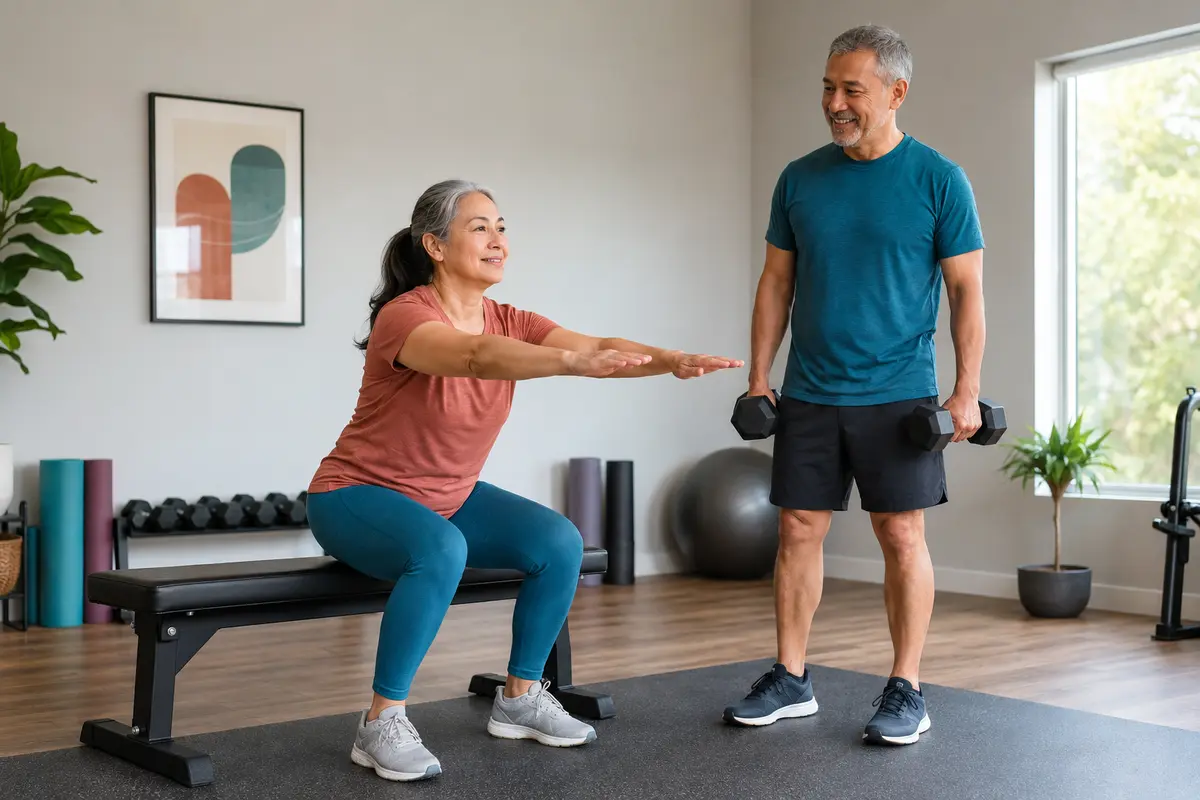
Sit near the front of a stable chair with your feet planted. Lean forward slightly, stand with smooth purpose, pause, and lower yourself over about three seconds. Begin with one or two sets of five to eight repetitions. Use your hands or a higher seat if needed.
The faster upward phase is optional. First earn it with pain-free control and enough strength to rise without rocking or collapsing inward at the knees.
2. Staggered-Stance Hold
Stand beside a counter with one foot slightly ahead of the other. Begin with a comfortable gap rather than forcing a true heel-to-toe position. Hold for 10 to 30 seconds, switch sides, and repeat once or twice. Narrow the gap only when you can remain steady without holding your breath.
3. Supported Step-Back
Hold a counter and take one controlled step backward, lightly touch the floor, and return. Begin with a small step instead of a reverse lunge. Practice four to eight repetitions per side. A deeper or quicker version is a later progression—not the starting point.
If stepping backward is not appropriate, substitute multidirectional toe taps: touch one foot forward, to the side, and slightly behind you while the standing leg stays softly bent.
Once these feel reliable, controlled side steps or 20-second purposeful walking intervals can add variety. Balance training should require attention while remaining safe enough to practice consistently. Rapid lunges onto an unstable surface are not a universal fall-prevention exercise.
Progress Without Turning Every Session Into a Test
Progress can mean adding a repetition, using slightly more resistance, walking a little faster, reducing hand support, or moving with better control. Change one important variable at a time.
Power also deserves context. It means producing force promptly, not recklessly. For some adults, standing from a chair with purposeful speed is appropriate. Others may need to build basic strength and confidence first. Exercise selection should reflect your health history, balance, joint comfort, and current ability.
Stop and seek appropriate care for chest pain, fainting, new severe shortness of breath, sudden weakness, or unexplained dizziness. If you have recently fallen, have significant balance problems, or are returning after a medical event, ask a qualified healthcare professional how to begin safely.
Coach Bob’s Takeaway
The updated model gives us a better definition of fitness after 50. The goal is not to train like a competitive athlete. It is to keep the physical qualities that help you respond to real life: strength to rise and carry, endurance to keep going, mobility to move comfortably, and balance and gait control to stay capable.
If your current routine is only one activity, keep the part you enjoy and add the missing pieces gradually. For help building a plan around your experience, equipment, joint concerns, and goals, book a free 20-minute strategy session.
This article is for general education and is not medical advice. Exercise recommendations should be adapted to your health, medications, symptoms, and abilities.