
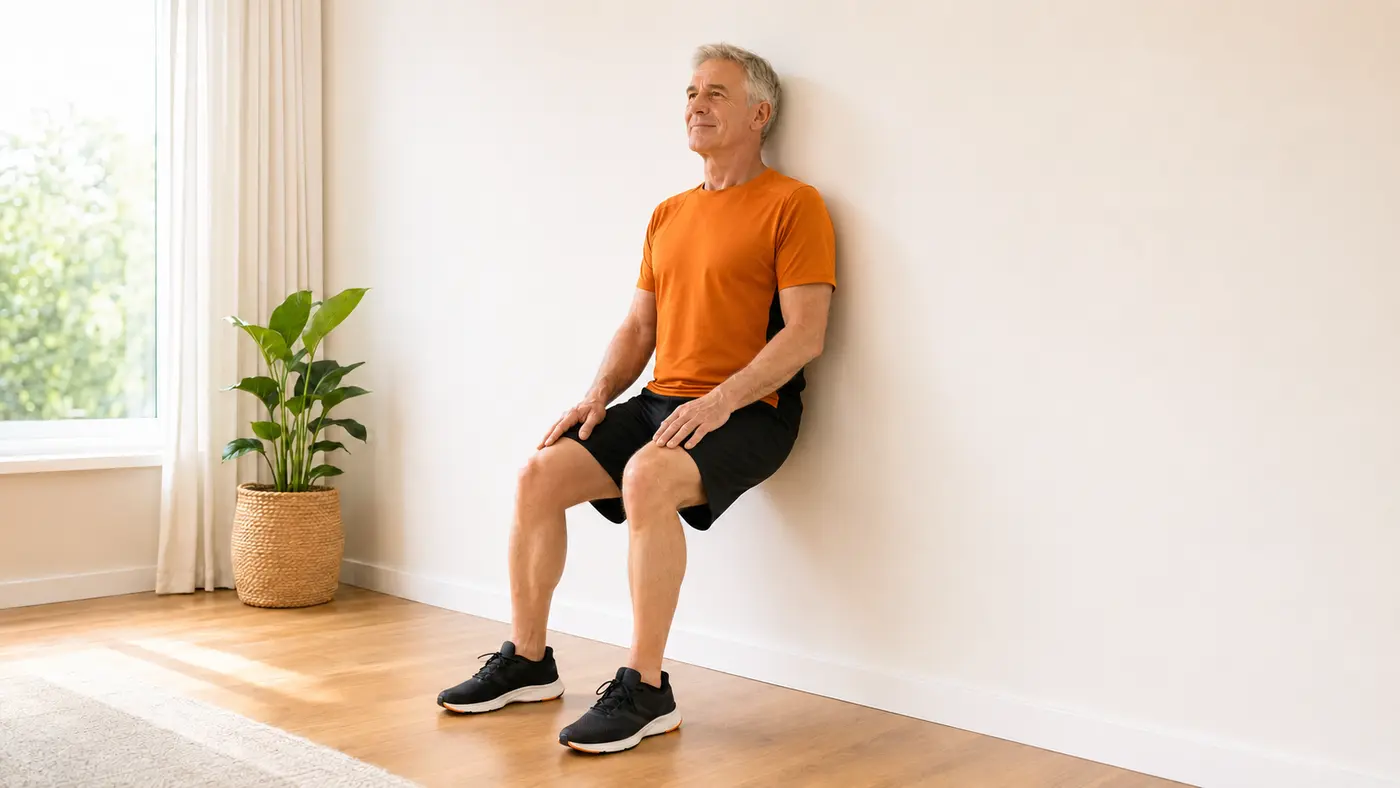
If you are over 50 and working to manage your blood pressure, you have probably been told to walk more or spend time on a treadmill. Walking is excellent for heart health, but arthritic knees, painful hips, or a sensitive lower back can make longer cardio sessions difficult.
There is another option worth discussing with your healthcare provider: isometric exercise. These are static contractions in which your muscles work while your joints move very little. A wall sit and an isometric handgrip are two common examples.
Isometric training is not a replacement for walking, prescribed medication, or medical care. It can, however, be a time-efficient addition to a well-rounded plan.
What the Research Actually Shows
A large 2023 review in the British Journal of Sports Medicine analyzed 270 randomized trials involving 15,827 participants. Every major exercise category lowered resting blood pressure. In the pairwise analysis, isometric training was associated with an average reduction of about 8.2 mmHg systolic and 4.0 mmHg diastolic. Wall squats ranked especially well for reducing systolic pressure.
A newer 2026 analysis in the Journal of the American Heart Association also found that isometric training can reduce blood pressure in adults with elevated blood pressure or hypertension. In that analysis, combined exercise and high-intensity interval training produced the largest average reductions. The practical message is not that one exercise makes every other form obsolete. It is that several approaches work, and the best one is the safe routine you can perform consistently.
Those figures are averages across groups and weeks of structured training—not a promise that one short workout will immediately lower your reading by a specific amount.
Why Holding Still May Help
During an isometric hold, a contracting muscle temporarily compresses some of the nearby blood vessels. After the hold ends, blood flow increases again. This response is sometimes called reactive hyperemia.
Repeated training may support healthier blood-vessel function through changes in endothelial function, nitric-oxide availability, nervous-system regulation, and arterial stiffness. Researchers are still studying how much each mechanism contributes, so it is more accurate to say isometrics may improve vascular function than to claim that one routine permanently “reverses” stiff arteries.
The Eight-Minute Detail That Headlines Often Miss
The best-known wall-squat research commonly uses four two-minute holds, usually with one to two minutes of rest between holds, performed three times per week for several weeks.
That equals eight minutes of working hold time per session, not eight minutes total for the entire week. Once rest periods and a warm-up are included, the session takes longer.
Two-minute holds are also demanding. Beginners should not force that duration on day one.
A Safer Wall-Sit Progression After 50
Before you begin: Ask your physician whether isometric training is appropriate for you, especially if your blood pressure is uncontrolled, you have cardiovascular disease, an aneurysm, retinal disease, a recent cardiac event, balance problems, or you take medication that affects blood pressure.
1. Warm Up for Three to Five Minutes
March gently in place, take an easy walk around the room, and move your ankles and hips through a comfortable range.
2. Set Up a High Wall Sit
- Place your back flat against a sturdy wall.
- Walk your feet forward slightly and slide down only to a comfortable height.
- Keep the knee bend shallow—about 45 degrees is a reasonable starting point.
- Keep your knees tracking in line with your toes.
- Choose a position you can exit safely without dropping to the floor.
3. Start With Short Holds
- Hold for 20 to 30 seconds while breathing steadily.
- Rest for 60 to 90 seconds.
- Repeat for two to four rounds.
When this feels controlled, add five to ten seconds to each hold over time. With medical clearance and good tolerance, you can gradually work toward longer holds. You do not need to reach two minutes to benefit from building a consistent habit.
Two Low-Movement Alternatives
Countertop push-hold: Stand at a sturdy counter, place both palms on the edge, and press firmly without letting your body move. Use moderate effort, breathe continuously, and stop well before your form breaks.
Towel pull: Hold a towel at chest height and pull outward with moderate tension while keeping your shoulders down. This can build upper-back and grip stability, although it has not been studied for blood-pressure reduction as extensively as standardized wall-squat and handgrip protocols.
These options should be treated as general isometric strength exercises—not as guaranteed substitutes for the exact protocols used in clinical trials.
The Most Important Safety Rule: Keep Breathing
Blood pressure rises temporarily during a hard static contraction. Holding your breath can make that spike larger. Exhale normally, avoid straining, and do not use all-out effort.
Stop immediately if you experience chest pain, unusual shortness of breath, dizziness, faintness, a severe headache, vision changes, or pain that feels sharp or unstable. Do not change or stop blood-pressure medication based on exercise readings without talking with the clinician who prescribed it.
The Takeaway
Isometric exercise gives adults over 50 a useful, low-movement training option. The strongest evidence supports structured practice over several weeks—not a single eight-minute quick fix.
Use static holds as one tool alongside regular movement, strength training, sleep, balanced nutrition, and the treatment plan you have established with your healthcare provider. Start higher, hold shorter, breathe normally, and progress only when your body is ready.
Ready for a joint-friendly plan built around your health, mobility, and goals? Visit Over50FitLife.com to book a consultation.