Stronger After 50: 4-Week Restart — Next group starts Tuesday, October 13, 2026 — enroll now or join the priority list
Visual companion guide
Joint-Friendly Muscle Building After 50
Build real muscle with controlled repetitions, thoughtful exercise selection, and gradual progression. This visual guide turns the Over50FitLife podcast and article into a practical two-day plan.
Use your browser's Print command to print or save this guide as a PDF.
!
Start with the version your body tolerates
Muscle effort is expected. Sharp pain, sudden instability, numbness, dizziness, chest pain, or unusual shortness of breath are not. Stop and seek appropriate medical guidance when symptoms are concerning. This educational guide does not replace medical care, rehabilitation, or individualized instruction.
Visual set 1 of 3
Day A: Legs, pressing, pulling, and hips
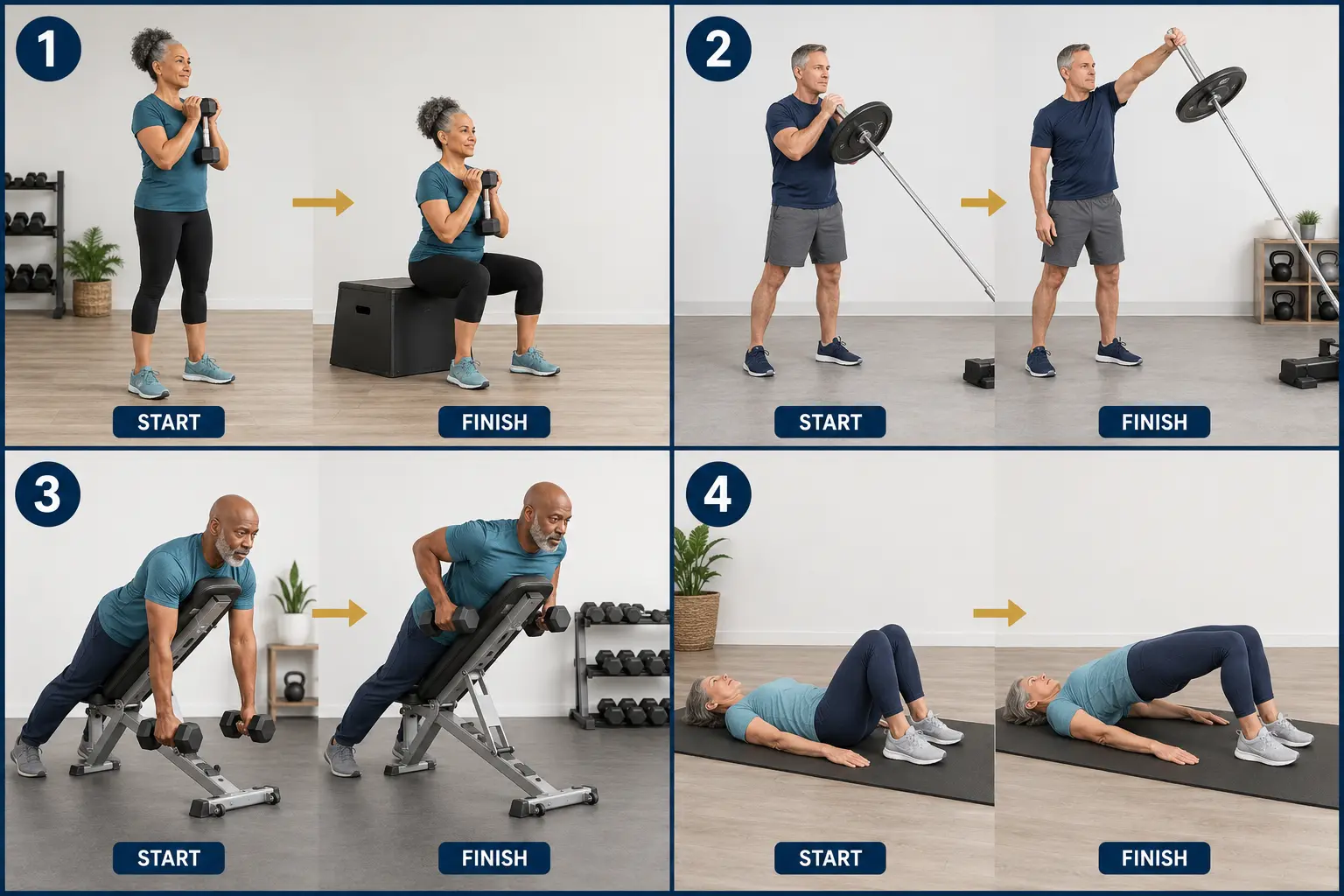
These first four movements train the largest muscle groups while using support, controlled ranges, and moderate resistance.
Use the numbered descriptions below for setup, movement, coaching cues, and easier substitutions. Illustrations show general positions; individual ranges will differ.
1
Goblet squat to a box
2–3 sets of 8–12 repetitions
Setup
Stand just in front of a stable box or bench with your feet at a comfortable width. Hold one dumbbell close to your chest.
How to perform it
Brace gently and reach your hips back as your knees bend.
Lower under control until you lightly touch the box—do not collapse onto it.
Press through your whole foot and stand tall without snapping the knees back.
Coach's cue: Keep the weight close, knees tracking with the toes, and use only the depth you can control comfortably.
If this version does not suit you: Use a higher box, perform an unweighted sit-to-stand, or use a leg-press machine if holding a dumbbell is uncomfortable.
2
Standing landmine press
2–3 sets of 8–12 repetitions per side
Setup
Anchor one end of a barbell securely. Hold the free end near one shoulder with a neutral wrist and a staggered or even stance.
How to perform it
Set your ribs over your pelvis and keep your shoulder relaxed away from your ear.
Press the bar upward and forward along its natural angled path.
Lower slowly to the starting position without letting the elbow flare sharply.
Coach's cue: Move through a comfortable shoulder path and resist leaning backward to finish the repetition.
If this version does not suit you: Use a half-kneeling position, an incline neutral-grip dumbbell press, or a machine press with a comfortable handle path.
3
Chest-supported dumbbell row
2–3 sets of 8–15 repetitions
Setup
Lie chest-down on a firmly positioned incline bench with a dumbbell in each hand and your arms hanging naturally.
How to perform it
Set your neck neutral and gently draw your shoulder blades back and down.
Pull your elbows toward your torso without lifting your chest from the pad.
Pause briefly, then lower until your arms are long without losing control.
Coach's cue: Let the upper back do the work. Avoid shrugging, jerking, or turning the row into a lower-back movement.
If this version does not suit you: Use a seated cable row, supported one-arm row, or resistance-band row.
4
Glute bridge
2–3 sets of 10–15 repetitions
Setup
Lie on your back with knees bent, feet flat, and arms resting comfortably beside you.
How to perform it
Brace gently and press through the feet.
Lift the hips until the shoulders, hips, and knees form a comfortable line.
Squeeze the glutes briefly, then lower one segment at a time without bouncing.
Coach's cue: Finish with the glutes rather than arching the lower back. Keep the ribs from flaring upward.
If this version does not suit you: Shorten the range, elevate the upper back for a hip thrust, or use a machine that supports your torso.
Visual set 2 of 3
Day A finish and Day B foundation
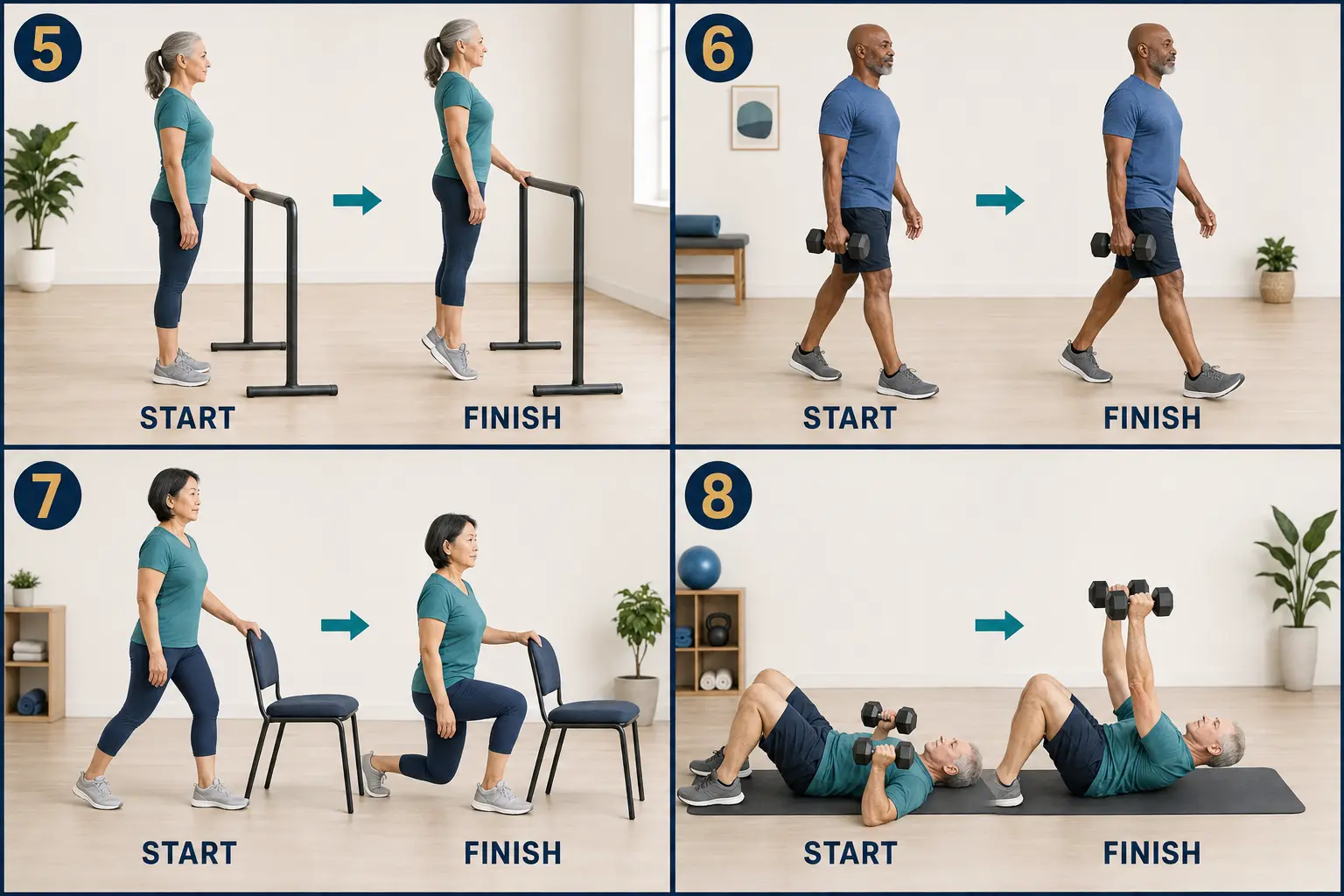
The calf raise and carry finish Day A. The split squat and neutral-grip press begin Day B with stability and controlled loading.
Use the numbered descriptions below for setup, movement, coaching cues, and easier substitutions. Illustrations show general positions; individual ranges will differ.
5
Supported calf raise
2 sets of 12–20 repetitions
Setup
Stand tall beside a stable support with your feet about hip-width apart. Use the support for balance, not to pull yourself upward.
How to perform it
Keep your knees soft and pressure even across the front of both feet.
Raise your heels as high as you can without rolling the ankles outward.
Pause, then lower slowly until the heels are fully controlled.
Coach's cue: Move straight up and down. Avoid bouncing at the bottom or rushing the lowering phase.
If this version does not suit you: Perform the movement seated, use a smaller range, or work one side at a time only after bilateral raises feel stable.
6
Suitcase carry
2 rounds of 20–40 seconds per side
Setup
Hold one dumbbell or kettlebell beside your thigh with enough open space to walk safely.
How to perform it
Stand tall with shoulders level and your gaze forward.
Walk with quiet, controlled steps while resisting the urge to lean toward or away from the weight.
Set the weight down with both hands when the interval ends, then switch sides.
Coach's cue: Think ‘tall and level.’ The goal is controlled posture, not the heaviest weight you can carry.
If this version does not suit you: March in place beside a support or perform a shorter carry with a lighter weight.
7
Supported split squat
2–3 sets of 8–12 repetitions per side
Setup
Stand in a comfortable split stance beside a stable rail, rack, or heavy bench. Keep both feet planted and use one hand for balance.
How to perform it
Lower your body straight down while allowing both knees to bend.
Stop before balance, knee comfort, or pelvic position changes.
Push through the front foot to return to the tall split stance.
Coach's cue: Use a stance long enough to feel stable. Keep the front knee tracking in line with the foot.
If this version does not suit you: Reduce the depth, use more hand support, or substitute a low step-up or leg press.
8
Neutral-grip dumbbell floor press
2–3 sets of 8–15 repetitions
Setup
Lie on your back with knees bent. Hold the dumbbells with palms facing each other and upper arms resting lightly on the floor.
How to perform it
Set your shoulder blades comfortably against the floor and keep wrists stacked over elbows.
Press the dumbbells upward without letting them crash together.
Lower slowly until the upper arms make gentle contact with the floor.
Coach's cue: Keep a neutral wrist and use the floor as a range-of-motion guide, not a surface to bounce from.
If this version does not suit you: Use one dumbbell at a time, an elevated push-up, or a converging chest-press machine.
Visual set 3 of 3
Day B: Back, hinge, shoulders, and arms
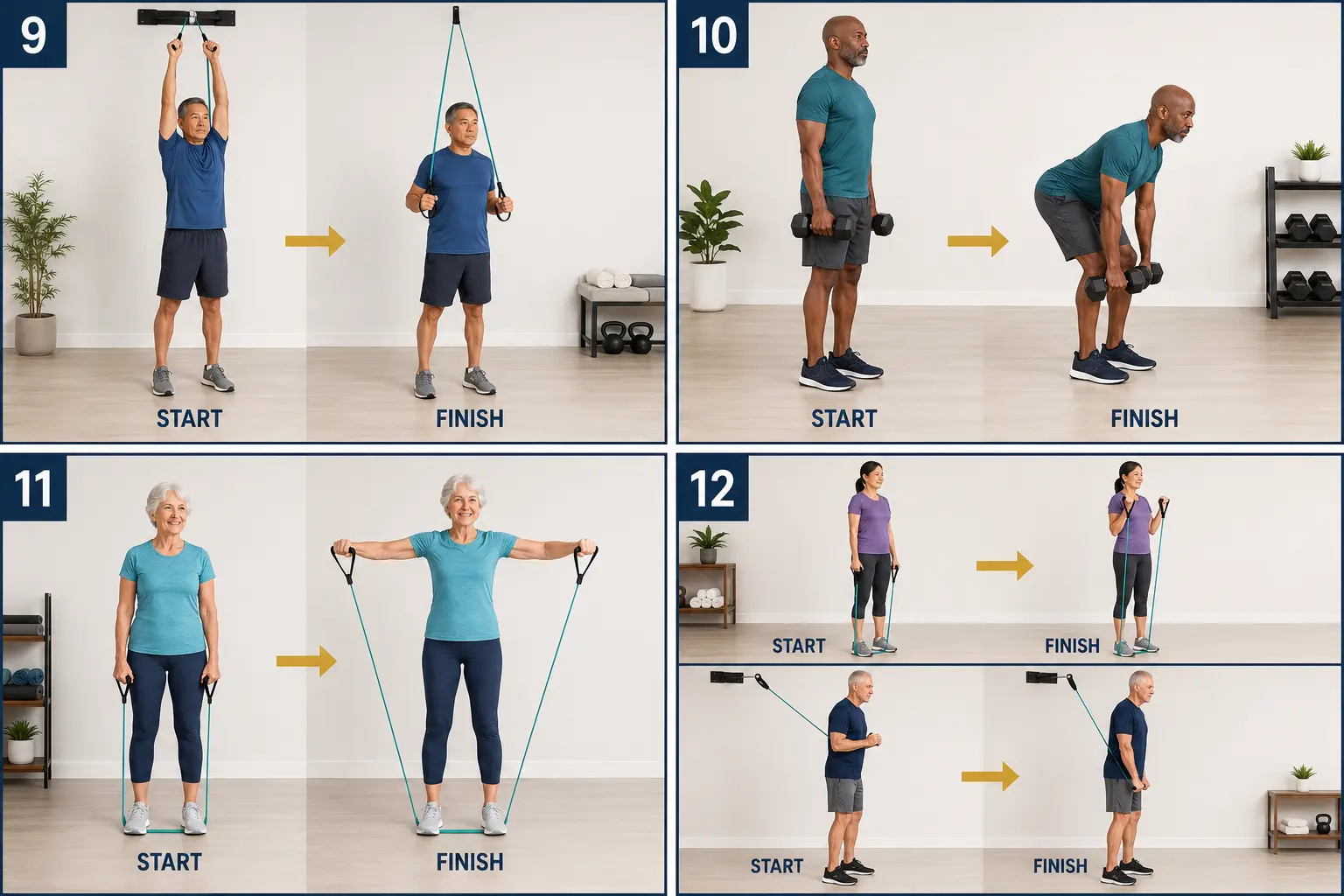
Finish the second session with a vertical pull, hip hinge, controlled shoulder work, and simple arm accessories.
Use the numbered descriptions below for setup, movement, coaching cues, and easier substitutions. Illustrations show general positions; individual ranges will differ.
9
Resistance-band pulldown
2–3 sets of 8–15 repetitions
Setup
Secure the band to a purpose-built overhead anchor and test it before beginning. Step or sit far enough away to create light starting tension.
How to perform it
Begin with arms overhead and ribs stacked rather than flared.
Drive your elbows down toward your sides while keeping the neck relaxed.
Return overhead slowly without letting the band pull you out of position.
Coach's cue: Use a smooth arc and stop if the overhead position creates shoulder pain or numbness.
If this version does not suit you: Use a neutral-grip cable pulldown, a lower anchor for a band row, or a smaller pain-free range.
10
Dumbbell Romanian deadlift
2–3 sets of 8–12 repetitions
Setup
Stand with dumbbells in front of your thighs, feet stable, knees softly bent, and spine comfortably neutral.
How to perform it
Push your hips backward while keeping the dumbbells close to your legs.
Lower only until you feel tension in the hamstrings without rounding or forcing depth.
Drive the floor away and bring the hips forward to stand tall.
Coach's cue: This is a hip hinge, not a squat. Let your range be determined by hamstring tension and trunk control.
If this version does not suit you: Use a cable pull-through, elevated kettlebell deadlift, glute bridge, or machine hinge.
11
Band lateral raise
2 sets of 12–20 repetitions
Setup
Stand securely on the center of a light band and hold the ends with arms resting near your sides.
How to perform it
Keep a small bend in the elbows and your shoulders relaxed.
Raise the arms out and slightly forward to a comfortable height—shoulder level is enough.
Lower slowly while keeping tension controlled.
Coach's cue: Lead with the elbows, avoid shrugging, and use lighter tension than your ego suggests.
If this version does not suit you: Perform one arm at a time while holding a support, or use a cable or very light dumbbells.
12
Band curl and triceps pressdown
2 sets of 10–20 repetitions each
Setup
For curls, stand securely on the band. For pressdowns, attach the band to a tested overhead anchor. Begin with light tension.
How to perform it
Curl: keep elbows near your sides, bend the elbows, squeeze briefly, and lower slowly.
Pressdown: keep elbows near your ribs, straighten the arms without snapping the elbows, and return under control.
Keep your torso quiet during both movements and stop before technique changes.
Coach's cue: The upper arms stay mostly still. Choose tension that allows full control at both ends of the repetition.
If this version does not suit you: Use light dumbbell curls and a cable pressdown, or perform one arm at a time for easier positioning.
Progress without chasing pain
Use double progression
Choose the listed repetition range and keep the same resistance until you can reach its upper end with stable technique and about two or three good repetitions remaining. Then make the smallest practical resistance increase and begin near the lower end again.
Own the range. Use a comfortable, repeatable movement.
Add repetitions. Progress one controlled repetition at a time.
Add resistance. Increase only after the upper range is solid.
Review recovery. Judge the joint during training and over the next 24–48 hours.
Make the plan fit you
Need help choosing the right variations?
Over50FitLife coaching can help you scale exercises around your current ability, available equipment, joint concerns, and goals.